Custom Search
Showing posts with label Southeast. Show all posts

Spring dead spot of zoysiagrass


Spring dead spot of bermudagrass
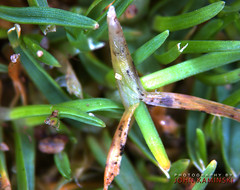
After a cold winter throughout much of the Southeast, damage from spring dead spot is particularly severe on bermudagrass. Scenes like this one are all too common when visiting golf courses in North Carolina right now.

We're also seeing an unusually high number of spring dead spot outbreaks on zoysiagrasses across the southeastern US. Samples, photos, and reports of spring dead spot on zoysiagrass fairways, tees, lawns, and landscapes have been rolling in all spring.

Spring dead spot of zoysiagrass?

Yes, this is not a new thing. Spring dead spot was first documented in zoysiagrass by Green et al. in 1993 as part of the zoysia patch complex, which turned out to be mostly large patch and a little bit of spring dead spot. The Color Atlas of Turfgrass Diseases by Tani and Beard also lists spring dead spot as a disease of zoysiagrasses in Japan. 

In North Carolina, we've seen spring dead spot on zoysiagrass every year since 2002 and documented that it is caused by Ophiosphaerella korrae, the same species that infects bermudagrass in this part of the country.

Spring dead spot of 'El Toro' zoysiagrass
Overall, zoysiagrass seems to be more resistant or tolerant to spring dead spot compared to bermudagrass. The patches are typically smaller and not as widespread. Given the superior cold tolerance of zoysiagrass, this makes sense. The problem is that zoysiagrass is even slower to recover from spring dead spot than bermudagrass. Although the symptoms may not be as severe, they can linger for extended periods of time.

Not all zoysiagrass varieties seem to be susceptible to spring dead spot. In Kansas the disease was observed on 'Meyer'. In North Carolina, most cases have been observed on Zoysia japonica varieties like 'El Toro' and 'Empire'. 

Spring dead spot of 'Diamond' zoysiagrass
This year is a little different in that we're seeing spring dead spot on more varieties. Most notably, we've confirmed the disease on golf course fairways and tees established with the Zoysia matrella cultivar 'Diamond'. To our knowledge this is the first confirmation of spring dead spot occurring on Zoyisa matrella.

Spring dead spot management on zoysiagrass is identical to that on bermudagrass. We've seen very good results from preventive application of fenarimol (Rubigan) in the fall. Regular cultivation during the summer also helps to reduce spring dead spot development and speeds up the recovery process. We're continuing to research the effects of nitrogen sources and other fertilization practices on spring dead spot development, but I don't have time to open that can of worms this week. Stay tuned for details on that in next week's post!


Why They Call it the Transition Zone


Spring dead spot of bermudagrass

As the old joke goes, "In the transition zone, we can grow all of the turfgrasses, we just can't grow any of them well".

The last year has been an excellent demonstration of this fact. Spring 2010 brought major problems with winter-kill in the warm-season grasses across much of the southeast. Everyone will remember the summer of 2010 as the year when record heat caused widespread failure of creeping bentgrass putting greens. 

Large patch of bermudagrass
The spring of 2011 hasn't been much kinder. Spring dead spot is particularly severe on bermudagrass this spring, and I've heard several reports of control failures from preventive fungicide applications. We've seen an unusual number of cases of spring dead spot on zoysiagrass as well (more on that next week).

Large patch (aka zoysia patch, aka brown patch, aka large brown patch....did I miss any? Seriously, can't we all just call it large patch?) is raging on all of the warm-season grasses as well. This spring is the first time I've seen large patch cause significant damage to bermudagrass in the Raleigh area. Zoysiagrass, St. Augustinegrass, and centipedegrass are affected very severely as well.

Many people struggle with these diseases of warm-season grasses because they have to be treated long before the symptoms express themselves. It is easy to forget about spring dead spot and large patch in the fall when everything is looking good. 

In addition, the economic downturn has led to severe budget cuts at many facilities, and the poor warm-season grasses are usually the ones that are left to fend for themselves without fungicide protection.

Over the next few weeks, I'll be writing in more detail about spring dead spot and large patch in the warm-season grasses. We'll cover things you can do now and during the growing season to help manage these diseases and how to prepare for preventive fungicide applications this fall. Stay tuned!


Rounds4Research Beginning to Pay Big Dividends


Visit Rounds4Research.com to find out more!
Due to the slumping economy, state governments across the country are struggling to meet huge budget deficits. This almost always means significant budget cuts at land grant universities that do turfgrass research. Some have been cut worse than others, but we're all feeling it in one way or another.

Most people don't realize that we receive little to no resources from our universities to run our programs. You want to hire a technician? Fine, come up with cash and then maybe HR can make it happen. Need to drive across the state to give a talk? You can go wherever you want if you can pay the gas bill. You want a cell phone? Sure, if you have the money you can do that too.

That's why the financial support that we get from the turf industry is so important. Without it, we can't do a thing. This is also why the recent decline in research funding from national organizations like the USGA and GCSAA is so troubling.

Many of the southeast's best golf courses participate in R4R
For as long as I can remember, people in the turf industry have been asking "How do we get the golfing public to support turfgrass research?" Several years ago, Tim Krieger of the Carolinas Golf Course Superintendents Association initiated Rounds4Research to do just that. Golf courses and resorts can donate rounds of golf or vacation packages to be auctioned off to the general public, with the proceeds going to support turfgrass research in the participating states. The Carolinas, Georgia, and Virginia are participating in 2011.

Last fall, the Carolinas GCSA funded 4 research projects at Clemson and NC State for a total of $94,225. The funded projects aim to address major issues like water conservation, nutrient fate, doveweed management, and perhaps most importantly, nematode control. Bruce Martin and I are collaborating on the nematode project, which I will write more about in the coming weeks.

If you have problems with nematodes, or just want to support turfgrass research in the Carolinas, Georgia, or Virginia, then it's not too late to participate in the 2011 Rounds4Research auction. Donations of rounds and golf packages are being accepted until April 4, and the online auction will run from April 10 to 17. All of the details can be found at rounds4research.com. Please help by encouraging your facility to donate, and also by spreading the word to golfers at your club about this rare opportunity to play golf at some of the nations top golf courses!

Fungicide Programs: Take this short survey and win!


Please help us to help you better!

We designed a short, 5 minute survey to better understand how golf course superintendents build and implement their putting green fungicide programs. Your valuable responses will be used to guide our future efforts to develop online tools and utilities for golf course turfgrasses.

One lucky participant will be selected at random to receive 2 free sample diagnoses from the NC State Turf Diagnostics Lab, a $200 value. But you must take the survey by March 21 to be eligible to win, so don't delay!

Click here to take survey

Thank you in advance for your assistance on this project!

How's the Spring Dead Spot?


This is probably the most common question I get this time of year as everyone anxiously waits to see how much disease there will be this year or if their preventive fungicide applications worked. Based on our winter weather conditions, with cold temperatures combined with periods of wet and dry weather, I expect the disease to be pretty severe this year and early reports seem to indicate that it's going to be a bad year. We've even had a report of a severe outbreak of the disease on zoysiagrass fairways.

Unfortunately, my travel is limited this time of year due to classes and conferences, so let me ask you: How's the spring dead spot out there? Any particular successes or failures with fungicides? Please post a comment to let us know what you're seeing!

Superintendents Encouraged to take Anthracnose Survey!


As you may remember a relatively large group of researchers from various universities across the country have been actively working on research related to the management of anthracnose basal rot of annual bluegrass. The project started about 5 years ago and was kicked off by gathering information from about 400 superintendents and turf professionals to figure out what was happening in the field and what was lacking the way of research-based recommendations. Well we have come to the end of the first phase of the project and are hoping to 1) gather information about your current management strategies and 2) utilize this information to fine tune our research priorities over the next 5-year phase of the project.

Thanks to the help of the Golf Course Superintendent's Association, we have launched our follow up survey that many of you requested to be a part of. Well now's your chance. Please help us in our goal of finding better solutions to your anthracnose problems by filling out the online survey.

Dollar Spot Expedition to Southeast Asia


Route through SE Asia
Dalat Palace Golf Club
Last week, I travelled throughout Southeast Asia with Dr. Micah Woods, international blogger and Director of the Asian Turfgrass Center, and Mr. Matee Suntisawasdi, Marketing Director for Procrop T&O. We went on an Indiana Jones-style expedition that included four countries (Thailand, Vietnam, Malaysia, and Philippines) and over 50 hours in the air. We found dollar spot in every country and collected isolates from many different grasses, including creeping bentgrass, velvet bentgrass, bermudagrass, seashore paspalum, zoysiagrass, and carpetgrass, just to name a few.

I want to thank everyone that made this trip possible by hosting us at their facilities. I owe a particular debt of gratitude to Dr. Woods, Mr. Matee, and Dr. Beth Baikan, who did the vast majority of the planning. The samples we collected will undoubtedly teach us a lot about this important turf pathogen.

Some highlights of the trip included:

Roger Jones making sand at Twin Doves
Kasetsart University, Bangkok, Thailand. This university is forming a team of scientists to work on turf. We met with agronomists, plant pathologists, and nematologists that are interested in turf, discussed some potential collaborative projects, and toured their brand new lab facilities.

Dalat Palace Golf Club, Dalat, Vietnam. A resort course and luxury hotel in the mountain town of Dalat with ‘SR1020’ creeping bentgrass greens. But the highlight of the day was when the assistant general manager, Mr. Ahn, took us out for goat prepared 5 different ways and a case or two of Heinekin beer.

Mount Kinabalu Golf Club
Twin Doves Golf Club, Ho Chi Minh City, Vietnam. A brand new golf course on the outskirts of Ho Chi Minh City planted wall-to-wall with ‘Platinum’ seashore paspalum. Roger Jones, the Director of Grounds, showed us the procedure he developed to produce sand that meets USGA specs from a local river sand.

Camp John Hay Golf Club
Mount Kinabalu Golf Club, Malaysia. Dr. Baikan, a fellow Rutgers graduate and environmental scientist in Malaysia, greeted us at the airport and accompanied us to this location tucked in the side of Mount Kinabalu at 5,000 ft above sea level. The course only gets 900 rounds a year due to nearly constant rainfall. The cool, wet, misty climate was perfect for dollar spot and we saw the disease on nearly every grass species on the property!

Camp John Hay Golf Club, Philippines. Originally built as a resort the US military, this course was redesigned by Jack Nicklaus in 1998 and is now a popular tourist destination. Because they were restricted in the number of trees that they were allowed to remove during construction, they constantly struggle with shade problems. It was interesting to see their experiments with different grasses and management strategies to overcome this hurdle.

Manila Golf Club
Manila Golf Club, Philippines. This immaculate seashore paspalum golf course is an oasis in the middle of the booming metropolis of Manila.

Manila American Cemetery, Philippines. Right next door to Manila Golf Club, this is the final resting place for over 17,000 American soldiers that were killed in the Pacific Theater during World War II. We were lucky enough to get a personal tour from the facility manager, Bert Caloud, who is an encyclopedia of World War II history. I really admire the work that they do there to honor the memory of those who gave their lives for this country.

Manila American Cemetery
Khao Yai, Thailand. On the last day of the trip, we took some time to relax, go on an elephant ride, and get ready for Super Bowl XLV!
Khao Yai

Some Whine with my Cheese


I said all along that Super Bowl XLV was the Steelers' game to lose. And that they did. You can't turn the ball over three times, without getting any in return, and expect to win against a good team.

But I must confess that I am mostly responsible for the game's outcome. Every time I place a friendly wager on the Steelers, they lose. Please accept my sincere apology, Steelers Nation, it will never happen again.

Megan and I agreed that if the Packers won, I would post a picture of myself wearing a cheesehead hat. I scoured the Raleigh area and couldn't find one, but we had this wedge of Dutch Gouda in the fridge so I figured that was just as good.

I have the utmost respect for the Green Bay Packers. It's a working-man's team from a working-man's town, much like the Steelers. Their head coach is a Pittsburgh guy, and I'm also a fan of Kevin Greene, Darren Perry, and Dom Capers.

But, seriously, is there a more ridiculous symbol of team fanaticism than wearing a foam block of cheese on your head? Vince Lombardi has to be rolling in his grave.

And before you start to make fun of the Terrible Towel, remember that it has many practical uses. People also forget that the proceeds of its sale benefit charity. It's seriously not cool to make fun of something that benefits disabled children.

For those who may say that I'm just jealous or bitter because the Steelers lost, you are absolutely right!

Megan's reponse to the superbowl win.


For those of you who wondered what happens behinds the scene with the turf disease bloggers, here is a little insight into our mind. Megan clearly has an opinion on the outcome of the superbowl between the Steelers and the Packers.

Is Emerald a Poor Curative for Dollar Spot?


Over the years, I've heard a number of people say that Emerald is a slow or poor fungicide for curative control of dollar spot. I must confess that I've never understood what everyone is talking about.

Given that boscalid, the active ingredient in Emerald, controls fungi by depleting their energy reserves, it makes sense that it might be a little slow to work on a curative basis. However, in reality, I've always been impressed with it's activity on both a preventive and curative basis.

Let's look at a couple of examples. In this first curative dollar spot control study, we had an average of 40 to 45 dollar spot infection centers in each plot before initiation of treatments. That's not a huge amount of dollar spot on a 20 square foot plot, but certainly enough to warrant a curative fungicide application in a golf course setting.

On July 20, just 5 days after applying the low rate of Emerald, we reduced the number of infection centers down to 2 per plot, whereas the number in untreated plots held constant. So, the low rate of Emerald reduced dollar spot incidence by 95% in 5 days. I'd consider that to be pretty good curative activity! If you're expecting more than this out of a curative application, then you are probably expecting too much.

Looking at some older data, in 2006 we evaluated Emerald, Daconil + Emerald, and Daconil + Banner for curative dollar spot control. In this case, the dollar spot pressure was much more intense, with 150 to 200 dollar spot infection centers per plot before the initiation of treatments. After the first application on 19 Jun, dollar spot incidence declined in all of the treatments at a similar rate and none of the treatments were disease free until three weeks later on 10 Jul. And this is even though dollar spot disease pressure was much lower during late June and early July, as evidenced by the decline in the amount of disease in untreated plots.

Curative control of any disease is more dependent on the level of disease pressure, the amount of turf injury present, and the growth rate of the turf after the application. Which fungicide is applied probably isn't that important in most cases. In order for the disease symptoms to go away, the turf has to grow out of the symptoms and spread into the damaged areas. This, of course, takes time. There aren't any fungicides that will make dollar spot go away over night.

For a lot of reasons, we don't recommend controlling dollar spot on a curative basis. Perhaps the most important reason is that curative applications increase the risk for fungicide resistance to develop. If you find yourself in a situation where you need to make a curative application for dollar spot control, be sure that you are tank-mixing with chlorothalonil to reduce the potential for resistance to develop. This is especially important for products with a high resistance risk like Emerald.

One last recap of 2010


from www.techdigest.tv
For those of you that have come to know me on this site, you probably also know that I am nuts. This is the kind of crap that keeps me busy during my insomnia in the middle of the night. Although this information is probably useful for web developers to make sure that the site shows up similarly across different platforms, I don't really have that much interest in the information. BUT, I do like the way that Google Analytics allows us to visualize the information. Without further adieu, here are the top browsers used to surf the Turf Disease Blog!

#7-10 Blackberry Phones
#6 Opera
#5 Mozilla Compatible Agent
#4 Chrome
#3 Safari
#2 Firefox (my personal choice)
#1 Internet Explorer

Check out the use during the year in this video!

Top 10 Visits by Country


As mentioned earlier in the week, we had visitors from 130 different countries or territories. While the majority by a long shot are from the United States, here is a round up of the top 10 visits by country in 2010:

#1 United States
#2 Canada 
#3 United Kingdom
#4 Thailand 
#5 Australia
#6 Japan
#7 Turkey
#8 Ireland
#9 Germany 
#10 South Korea

Top 5 Blog Posts of 2010


There's no doubt about it, 2010 was a tough year for golf course superintendents. Here's a look back and what was most important or relevant to you from our site last year.

#1 Bacterial wilt of bentgrass...
This was the posting of a letter from Dr. Mitkowski of the University of Rhode Island in which he talks about his recent finding of bacterial wilt in bentgrass. Definitely a hot (and controversial) topic in 2010.

#2 Summer fungicide programs for cool-season putting greens
There is no doubt that those growing bentgrass in the Southeast United States had their hands full this summer. In this post, Dr. Tredway shares some early (June) information about planning your summer fungicide programs with special mention to specific diseases including: Pythium blight, Pythium root rot, Pythium root dysfunction, anthracnose, fairy ring, nematodes and brown patch.

#3 Bacterial Wilt, no not? That is the question.
Dr. Wong posts a September blog about recent reports of dying annual bluegrass and creeping bentgrass greens. He links to a few other posts and suggests that although bacterial wilt may be the cause, getting conditions required for the disease in Southern California would be "like coordinating a trainwreck."

#4 Beware of the DMI fungicides
 In another post by Dr. Tredway, he warns of the potential issues with using the DMI fungicides during the summer months. This post was on June 16, so hopefully you heeded his warning and backed off of these products during the intense summer we had. If you didn't then you likely played right into the hands of Pat O'Brien and went through or are planning a bermudagrass conversion!

#5 The Turf Diseases Image Gallery
Did you even know that the Turf Diseases blog had an image gallery for the various common diseases that you may see at your golf course. Hosted on flickr and utilizing images from Dr. Tredway and me, the gallery serves as a visual tool to help diagnose your turf diseases problems or even as a photo collection for you to build powerpoint presentations for your club (giving full credit to the photographers of course).

Top 10 Referrers of 2010


While we would love to think that all of you have us booked marked or saved as your browser's homepage, we definitely understand and appreciate the fact that many of you find us by clicking on links from referring sites. We want to recognize those sites for providing content or links that got your to us. So to steal the thunder from David Letterman, here is our:


 Why they drove visitors to our site-list.

No. 10: It was either you or Voodoo Donuts.

No. 9: Wait, we did what?

No. 8: สิ่งที่เราควรทำอย่างไร

No. 7: I guess the words "disease" and "porn" are closely related.
(Google images)

No. 6: Because we don't update during our insomnia.
(Golf Course Industry) 

No. 5: Even we're tired of listening to Kaminski.

No. 4: @turfdiseases needed more followers.
(Twitter)

No. 3: We ran out of money to produce more Frank Rossi videos.
(TurfNet)

No. 2: This is what we do, dumbass.
(Google)

...and the number 1 reason our referrers said they drove traffic to our site...

No. 1: Because we're trying to drive the old people from our own site.
(Facebook)

Turf Diseases 2011 Recap


Now that 2010 season is finally over, it is time for us here at Turf Diseases to recap some of the highlights from the past year. This week I will bring you some "Top Lists" for the website. I am happy to say that we have branched out beyond just what happens here in the United States. To the right you can see that although our focus audience is here in the states, we are reached 130 countries/territories in 2010.


Over 57,000 visitors (over 24,000 unique visitors) frequented the site last year (figure below). It was clear that there were a few hot spots in terms of times to visit. Needless to say it is obvious that things were tough in July and August and this caused many of you to I assume check out what was happening around your region and with other golf course superintendents as well.


The 2010 Top 10 List...
Some other things of note coming up this week include my version of Letterman's Top 10 for the following categories:

Top referrers to the website in 2010 (some of you made the list!)
Top Posts of 2010 (based on your visits)
Top Visits by Country (see how your country stacks up)

Special Turf Nerd Post (you could probably do without seeing this one)

What the future holds...

The 2010 season marked the first full year of our existence and we couldn't be more happy with the results. In fact, the success of this little blog site has inspired me to expand in 2011 with the hopes of something big by 2012 (sponsors beware). If you have any ideas on how we can improve the site (big or small), please feel free to share it with us in the comments below!

Civitas Update....By Popular Demand


First, my apologies for the tardiness of this post. The pre-Thanksgiving travel crunch got the best of me last week, and of course I spent the entire weekend watching football and hockey, so I am just now getting caught up! Several people have asked what happened to the Civitas update, so here it is:

Civitas is a new product for disease and insect control in turfgrasses that was developed by Suncor, formerly known as PetroCanada. The active ingredient is mineral oil, otherwise known as 'horticultural oil', which has been used for management of plant pests for many years. It has just never been used in turf because of issues with phytotoxicity. However, Suncor developed a pigment product, called Harmonizer, that is mixed with Civitas to reduce the potential for phytotoxicity. The advantage of mineral oil as a fungicide is that it has very low environmental impacts due to its low toxicity and rapid breakdown in the environment.

Because it contains oil and pigment, Civitas has a very noticeable effect on the color and appearance of the turf. The Harmonizer pigment, depending on the application rate, is a very dark green, similar to that provided by an application of Triton Flo or Tartan. Some people have complained that transfer of the pigment to shoes and clothing has been a problem, but I haven't rolled around on our research plots yet to see how big of a problem that is.

The mineral oil component of Civitas also gives the turf a distinct greasy appearance, very similar to that caused by an application of a wetting agent like Cascade. This greasy appearance is most evident in the morning and persists for several days to a week after application. Because of these unique characteristics of Civitas, I suggest that people try it out on a nursery green or putting green before treating the whole course with it.

We've been evaluating Civitas for control of various turf diseases for three years now. For a summary of our previous results, please see my post from last year entitled Civitas shows promise for control of dollar spot and brown patch. Be sure to read the comments at the bottom provided by Wakar Uddin, Bruce Clarke, and others regarding their experiences with Civitas.

We continue to see similar results against dollar spot and brown patch in our trials. However, this year we ran into serious problems with phytotoxicity when Civitas and Harmonizer was tank-mixed with Daconil and Banner Maxx. The injury appeared very quickly after the first application in May and became more severe as time went on. As you can see in the graph to the left, it is also interesting to note that half rates of the mixture components did not reduce the amount of phytotoxicity observed. Based on this result, we definitely recommend that Civitas and Harmonizer should not be mixed with Daconil and Banner, or with other fungicides until we have the opportunity to evaluate more mixtures for their safety.

We haven't seen significant phytotoxicity from applications of Civitas and Harmonizer alone in our trials, but some users have reported injury during times of severe stress, with high temperatures consistently above 90F. It makes sense that it could create problems to coat the turf leaves in oil under these types of conditions.

To summarize, Civitas has good activity against several important turf diseases like dollar spot, brown patch, anthracnose, and leaf spot diseases. Although it does not provide acceptable control alone in most cases, my opinion is that it could be useful as part of a disease control program. Civitas and Harmonizer should not be mixed with other fungicides or applied to severely stressed turf, or severe injury could result. However, if you are interested in using products that pose less risk to environment, then Civitas is a good choice.

New Granular Fungicides for Turf


Historically, fungicides on granular formulations have never been used frequently on turf. With the exception of late fall snow mold applications and damping off applications to the seedbed, there weren't many situations in which granular fungicides were recommended.

Two things were limiting the usefulness of granular fungicides: a limited selection of products and low-tech carriers that weren't very effective for foliar disease control. As a result, my standard recommendation has always been that if you want good disease control,  you should spray instead of spread. As an example, look at the tall fescue plots to the left that were both treated with triadimefon at the same rate of active ingredient per acre. Triadimefon is not a very effective brown patch fungicide to begin with, but the sprayable formulation (Bayleton) is much more effective that the granular formulation (Fungicide VII).

Things changed quickly, though, and today many more products are available on granular carriers, including recent products like Armada, Disarm, Heritage, and Headway. Several others are currently being tested as experimentals. Furthermore, these new products take advantage of modern granular formulation technology that makes them more effective against foliar diseases by increasing foliar absorption of the active ingredient.

We've evaluated a number of these new granular formulations, mostly against brown patch in tall fescue in a lawn care scenario. I will include a couple of examples here. I would summarize by saying this: these new granulars are more similar to their sprayable counterparts for brown patch control, but generally their efficacy is a erratic and they require more frequent applications. I still think that if you have the capability to spray, it's still better to spray. But these products provide more options to turf managers in situations where spray applications are not possible or practical.

Another possible advantage of a granular formulation is for control of root diseases like summer patch, spring dead spot, fairy ring, take-all patch, etc. To control these diseases most effectively, you obviously want the active ingredient to be in the root zone. With a granular, you can make the application and then water in later at your convenience, rather than having to worry about running the heads right behind the sprayer before it dries on the foliage. While we haven't tested these newer products against root diseases, we always used to see very effective spring dead spot control from granular formulations of Rubigan.

I'd like to hear some comments from our readers on this topic: What are the advantages and disadvantages of these granular formulations in your experience? If you are using these products, how and for what are you using them?

Theme Week: "New" Fungicide Reviews


As a way to increase our postings during the winter months and keep providing relevant information to golf course superintendents, the Turf Disease Blog has decided to do a series of "Theme" weeks in which each blogger tackles a topic within the theme.  Thanks to Dr. Tredway for coming up with the idea.

Our first theme is going to focus on reviews of individual fungicides that are relatively new to the market. Each blogger has simply been told what fungicide to review and what day to post. Other than that, there are no restrictions or guidelines as to the material presented.  I suspect that you will see a little data and some decent summaries of the strengths, weaknesses and potential issues with each fungicide.

"New" Fungicide Reviews*

Monday 11/15: Interface
Wednesday 11/17: Instrata
Thursday 11/18: Endorse/Affirm
Friday 11/19: Reserve
Monday 11/22: Concert
Tuesday 11/23: Civitas
Wednesday 11/24: Honor
Thursday: 11/25: Renown (posted 11/28)
Friday 11/26: Trinity/Triton
*Reviews of individual fungicides by authors of this blog do not endorse, promote, or in any way recommend the use of specific products. Reviews are based on public information, personal experience or company input. If you have questions or comments about the individual reviews, we encourage you to share your thoughts in the comments section of the individual blog post. Your question or comment may be something that provides valuable information to others reading the blog. Authors will do their best to respond to questions/comments in a timely fashion!

If you are interested in learning more about some of the fungicides that are now available, check back over the next two weeks.  Yes, I said TWO WEEKS...the idea was so good and there were so many fungicides that we decided to have everyone tackle two products and post through the week of Thanksgiving...sorry Megan!

Your Input Requested!
Do you have an idea for an upcoming "Theme Week"? If so, then leave us a comment below OR on the Facebook page. We can't promise we will get to them all, but we will do our best to address your concerns during the winter months while disease pressure is low!

More on the DMIs and Bermudagrass Greens


It is often said that good research raises more questions than it answers. Maybe the same can be said about blog posts? And no, I am not referring to Megan's California Gurls post from last Friday. (Side note: My main motivation for posting today was to bury that thing as quickly as possible. No pun intended.)

In last week's post about Torque for spring dead spot and fairy ring control, I casually mentioned that tebuconazole can injure ultradwarf bermudagrass putting greens. Since then, I've had a lot of questions about Torque and other DMIs and their safety on bermudagrass greens. It's a complex issue, and one that we don't have all of the answers to. Your questions will motivate us to do more research on this next year.

Although many of the newer DMI fungicides on the market are more safe on cool-season putting greens, they can be more injurious on bermudagrass greens. Looking at the graph to the left, you see that applications of Trinity (triticonazole) and Lynx (tebuconazole) caused severe damage to Tifeagle bermudagrass, Bayleton caused a slight reduction in quality, and Banner and Eagle had no effect. This is almost exactly the opposite of what you would see on creeping bentgrass or annual bluegrass putting greens.

Of course, application rate and time of year influence the amount of injury that is caused by DMIs, with the greatest injury caused by high rates, repeated applications, and high temperatures. You will notice that in the above example, we made 5 applications in a row at high label rates during the heat of the summer. No wonder some of them caused injury!

However, don't make the mistake of thinking that that all of the DMIs are safe on the ultradwarfs in the fall and spring or if you're only making one application. As an example, refer to my post from last fall entitled Effects of DMI Fungicides on Bermudagrass Putting Greens. In this example, we saw pretty significant phytotoxicity from some of the DMIs even after one application when temperatures were relatively mild.

I don't mean to scare everyone away from using the DMIs. We never see issues on bermudagrass fairways or athletic fields, and some of the DMIs are perfectly safe on greens. Just choose your products wisely and don't jump on the newest products right away just because they are new!

A New Option for Spring Dead Spot and Fairy Ring Control


Earlier this year, the Cleary Chemical Company released a new fungicide called Torque, which contains the DMI fungicide tebuconazole. More recently, Cleary obtained a 2ee label for the use of Torque for fairy ring prevention. Although it is just another DMI, tebuconazole has some unique properties that should make Torque a very useful product for golf course superintendents.

In particular, we've had a lot of questions about the use of Torque for spring dead spot and fairy ring prevention. Although we have not had the opportunity to evaluate Torque against these diseases, we have a lot of experience with a variety of tebuconazole formulations from other companies.

What we can say is this: tebuconazole is very effective for prevention of both fairy ring and spring dead spot. For spring dead spot, we've seen excellent results in bermudagrass fairways and athletic fields from two applications of tebuconazole, 30 days apart, at the high label rate prior to the onset of dormancy. Unlike Rubigan, which only requires one application in many circumstances, we've found that two applications of tebuconazole are necessary to achieve the best spring dead spot control.

Tebuconazole has also provided excellent prevention of fairy ring caused by puffball-type fungi in sand-based putting greens. Following our standard recommendations, two applications of tebuconazole at the recommended rate on a 30 day interval, beginning when soil temperatures consistently exceed 55F, has been a very effective program.

A note of caution for those with ultradwarf bermudagrasses: we've seen severe injury on the ultradwarfs from tebuconazole, and the Torque label says 'Bermudagrasses can be sensitive to Torque Fungicide under certain conditions'. Until we can get a better feel for the safety of Torque on bermudagrass greens, I would stick with older products that are known to be safe.
Related Posts with Thumbnails