Custom Search
Showing posts with label brown patch. Show all posts

No kind words for September


The average high for yesterday (Sept 1) is 87. We beat the old record (107) with a high of 108. Yuck. I kept thinking "Just wait til September... just wait til September." Well, September, I have some special words for you, but I'm too much of a lady to type them in this public blog. Click on the image below to zoom in on our summer-of-fun. This particular data is from here in Manhattan.


This time of year can be marked by extremes. The record lows are in the 40's, but there have been triple digit record highs almost all through September. Wild mood swings.

Fungicide trial

This year my PhD student Ken Obasa and I have been conducting a fungicide study on the putting green looking at a couple of fungicide programs, and a new product called Velista which should be released soon. All treatments are applied every two weeks. Velista is tested at 0.3 and 0.5 oz/1000. Here are the programs:

Program 1:

10 May Honor 1.1 oz

2 June Insignia SC .7 oz

17 June Spectro 90 5.75 oz

30 June Signature + Daconil 4 oz + 3.2 oz

14 July Insignia SC .7 oz

28 July Signature + Daconil 4 oz + 3.2 oz

11 Aug Chipco 26GT 4 oz

25 Aug Honor 1.1 oz

Program 2:

19 May Headway 3 oz

2 June Heritage TL 2 oz

17 June Spectro 90 5.75 oz

30 June Signature + Daconil 4 + 3.2 oz

14 July Heritage TL 2 oz

28 July Signature + Daconil 4 oz + 3.2 oz

11 Aug Chipco 26GT 4 oz

25 Aug Headway3 oz

Program 3:

19 May Disarm M 1 oz

2 June Disarm .36 oz

17 June Spectro 90 5.75 oz

30 June Signature + Daconil 4 + 3.2 oz

14 July Disarm .36 oz

28 July Signature + Daconil 4 + 3.2 oz

11 Aug Chipco 26GT 4 oz

25 Aug Disarm M 1 oz

Program 4:

19 May Tartan 2 oz

2 June Compass .25 oz

17 June Spectro 90 5.75 oz

30 June Signature + Daconil 4 + 3.2 oz

14 July Compass .25 oz

28 July Signature + Daconil 4 + 3.2 oz

11 Aug Chipco 26GT 4 oz

25 Aug Tartan 2 oz

We had a severe brown patch epidemic in early/mid August, and brown patch reached about 40% severity in the untreated plots. All the programs and the two Velista treatments held the disease to 0%.

Dollar spot pressure has been fairly low but with cooler temperatures I suspect it will flare up in the next week or two and probably though most of September. I’ll post some details later on.

.

.

A plant pathologist's dream come true - patch-a-rama


Hello out there,

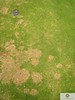
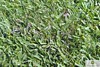
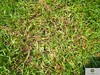
I don't have too much to report, but we are having an impressive outbreak of brown patch this week at our research facility. I wanted to get a lawn chair and just sit out there on the research green and take it all in. Here are some images, smoke-rings included.

With moss:

With dollar spot:

With scalping injury:

The temperatures have dropped, with highs in the coming days in the 90's and even some 80's in most of Kansas. In southern Kansas it looks like there will be a few more days of ~100 then some 90's and 80's. Poor Oklahoma still looks super hot, though. Ugh.

Some parts of Kansas also got some rain yesterday and today, but many areas missed out. Our KSU turf field day got rained on yesterday in the Kansas City area.


.

.

Light at the end of the tunnel (e.g., It's August)


It's been a busy week for golf course superintendents in the region as diseases are in high gear and the heat and temperature stress are causing many golf course putting greens to decline. We are hearing a lot of reports of yellowing and discoloration to bentgrass putting greens, possible nematode issues, and the typical diseases that we would expect to see at this time of the year.

Rain storms that swept through much of the mid-Atlantic provided some much needed relief from the drought we were in, but in many cases the rain fell too fast and basically moved via the surface. The good news from that was that many of you who had ponds that were getting low got a "refill". The bad news is that this did little for replenishing the soil and also washed out a few hundred bunkers. There were even reports in parts of southeast PA of flooding due to the massive storm that came through last week. On the other hand, there were also courses that DID manage to get the slow and steady rain that helped to wet the soil. Following these rains, dollar spot became VERY active and anyone not covered with fungicides saw cotton candy fairways on Tuesday.


Heat stress continues to be the biggest issue throughout much of the region and I can't stress enough that just because the turf is declining doesn't mean that it is pathogen related. In many cases, the soil temps are just too high and/or the growing environments too poor. As we hit the home stretch of summer, it is important to continue to be diligent on your water management. Yes, I know that it is not practical for many of you to get out there and hand-water everything as the courses with a $2,000,000 budget do, but the bottom line is that if you are using your overhead irrigation to "syringe" then you are probably over watering (this was from a USGA agronomist who I believe it going to write an article about it for an upcoming issue of the USGA Record).

Active right now: dollar spot, brown patch, Pythium blight, anthracnose, fairy ring, summer patch, others?

Website update: We are in the process of finalizing the details/construction of the new website for Turf Diseases. Some planned features include:
  • More authors for more updates
  • Restructuring of regional updates in line with USGA Regions
  • New "Research" section for the latest research updates from the scientists
  • New "Tech" section (you'll have to wait for the launch to find out more)
  • Disease profiles and Image galleries
  • Disease updates from superintendents

Lots o' Heat and Brown Patch


Well it looks like most of the country is in the grip of this heat wave now. We are working on day 29 of days over 100 F for 2011. According to the Oklahoma Climatological Survey map, we average approximately 15 days per year over 100 F. Our record is 50 days and we haven't even made it to August when we typically have our "hot and dry" weather. So….it is going to be a tough summer season again this year.

In our diagnostic lab we are getting a lot of creeping bentgrass samples with high nematode populations and/or suffering from good old summer stress symptoms. I predict that these issues are going to persist for us for the near future and putting greens will continue to become increasingly stressed. Remember, if you have that “big tournament” coming up and the membership is asking how fast they will be rolling, remind them to expect slow. The last thing you want to do during the weather we are having is try to make the greens roll ultra fast and throw a bunch of traffic on them when it is 105 F and the wind is blowing 25 mph! Again I say slow greens are better than no greens. Hopefully everyone has their smooth rollers on and they have reduced mowing as much as they can to manage plant stress. Be sure to have a good preventative fungicide program in place for Pythium diseases and brown patch.

Speaking of brown patch, we have a pretty good epidemic going on most of our research putting greens at the Turfgrass Research Center in Stillwater. Last week we had several evenings that we had humidity above 85%. For the entire month of July we have not dropped below 72 F at night in Stillwater. These conditions have been perfect for brown patch development. As most of you already know, preventative fungicide programs are the best strategy for managing the problem. So what is a good program for the Oklahoma area? Well, each year we conduct various dollar spot and brown patch trials on creeping bentgrass putting greens. These programs are often elaborate and often not cheap! Here are some brown patch data from our 2010 program trials. These trials were on a 'Penncross' putting green with a USGA sand/peat base located at our Turfgrass Research Center in Stillwater. Brown patch data were most severe on the July 16 rating, so I'll focus on that rating and on only the products applied up to that rating. You will find the products and the application dates in the table. Note that all applications were on a 14-day interval. For good control of both dollar spot and brown patch we don't recommend stretching your fungicide interval much past 14 days in our neck of the woods. Also, the DS ADVISORY treatment was an experimental exercise where we were targeting control of only dollar spot by advising sprays using a statistical model. Therefore, no brown patch products were applied resulting in high levels of brown patch.

So what happened? Well, highest levels of brown patch were recorded in the non-treated check plots with an average of 60% of the plot area symptomatic. Somewhat lower levels of brown patch were recorded in plots treated according to the ADVISORY program, but remember this program really doesn’t count when we are talking about brown patch control. All other plots treated with fungicide had significantly lower levels of brown patch and were not different from each other. Although, the OSU2 program had the lowest levels of brown patch (5% severity). Average turfgrass quality was lowest in plots not treated with fungicide and was considered unacceptable. Marginally higher levels of quality were recorded in plots treated by the ADVISORY. All other plots treated with fungicide had the acceptable levels of quality, however, the BASF1 and BAYER1 programs were a bit lower than the others. No symptoms of phytotoxicity were observed. So what this demonstrates is that if you start off with a good preventative fungicide program and make a reasonable decision about the products relative to the pathogens you expect to control, you will be reasonably successful at managing a disease like brown patch.

Summer stress and diseases


HOT HOT HOT

We've been cooking over the past week.


We are not as bad as Oklahoma. Just reading Damon's post made me break into a sweat, both with the thought of those high temperatures AND the thought of the number of samples he's dealing with. It hasn't been quite that extreme just a bit north, where I am located. But, this current week has been nasty, with more 100+ on the way.


Localized dry spot:

This photo was sent in with a subject line that said “Help!!!”

While I am not a fan of diagnosing based only by photo, the pattern made me suspect localized dry spot (hydrophobic soils) and I suggested that they do the “droplet test” which is described HERE. Indeed, that was the problem. A wetting agent will be useful, but unfortunately the turf itself will not be able to recover very well until these extreme temperatures go away… and that could take awhile.


.

.

Brown patch in creeping bentgrass:

Hot and humid, with high night-time lows = optimal conditions for brown patch. It’s active in greens, fairways, and lawns (fescue).

Dollar spot, in an unsprayed fairway area (creeping bent)

I've also seen some anthracnose in the past few days.

Heat Wave Forecasted for Next Week


We have seen relatively few disease issues in the TDL the past month or so. Throughout Upper Midwest temperatures have been warm, but we have also been quite dry. However the forecast for next week is very different. Highs for next week will been in the low to mid-ninties, more importantly night time temperatures will exceed 72 for most of next week. I included a 7-day forecast from NBC 15 here in Madison, but areas west and south of us will likely experience even hotter temperatures. I know that doesn't compare with the excruciating heat experienced by those in the Southeast and Central US, but the forecast is significant for the Upper Midwest. Especially considering that many courses have substantial Poa annua populations.

IF YOU haven't done so already, this weekend or early next week is a great time to protect your plants against brown patch and Pythium blight. Environmental conditions next week will be ripe for these two diseases. Moreover, anthracnose, dollar spot, summer patch and leaf spot could also flare up depending on where you are with fungicide applications. I mention leaf spot because we have been dealing with a Bipolaris leaf spot in the Midwest for two or three years that does not respond well to applications of iprodione. This disease also remains active throughout the summer months and has been problematic primarily for older golf courses. The disease tends to be more severe on certain clones of older creeping bentgrass fairways causing a "splotchy" reddish appearance to fairways. It does not manifest into distinct symptom. An image of typical stand symptoms is below.


Last year we initiated a fungicide trial at a course in Wisconsin to investigate chemical control options and found that Heritage TL, Insignia and a tank mixture of Chipco 26GT and Daconil Ultrex suppressed symptoms when compared to the non-treated control. Chipco 26GT by itself did not suppress the symptoms, indicating that Daconil Ultrex was more effective in controlling this disease. Note that I use the word suppress we have not been able to prevent the development of this disease, only suppress the symptoms. Here is the report from last year's trial. This has been a difficult disease to work with because it only seems to affect certain clones. Thus it took some time to figure out how to rate it.

Some other things to consider for next week: limit mowing by alternating mowing and rolling, skip clean-up passes, raise the mowing height and absolutely avoid applications of DMI fungicides to putting greens.

A Blog and Disease Update


So far the summer has been very busy for all of us and I personally apologize for not posting as much as I would like. You would think that posting an update a week would be easy, but it is once again proving difficult with all of the research, internship visits, website development and other things that I am currently working on. The good news is that we are rolling out several new bloggers to the site in the next month. I will let them introduce themselves in their first post as Dr. Damon Smith did in his first post from Oklahoma. We are also working on a redesign and launch of a more substantial website (not sure of a roll out date, but at this rate it will be in 2012) which will provide even more information about turfgrass diseases and likely some other areas of focus. So look for that in the future and in the meantime please welcome our new bloggers as they start to post!


In terms of diseases around the region, there is still a lot of talk about the etiolation of bentgrass on putting greens in the mid-Atlantic (and other areas as well). While there have been reports of a bacteria found in association of these symptoms there are as many reports of the symptoms being present without any bacteria found. The bottom line is that the verdict is still out regarding the cause of these symptoms and the impact that this will have as we move closer to the middle of the summer. While I am still skeptical about topic as a whole, I concur that if you are experiencing these symptoms you should perform basic cultural practices to minimize stress as if you had bacterial wilt. These include:
  • Raising mowing heights
  • Utilization of a dedicated mower for the affected greens
  • Mowing when the greens are dry
  • Maintaining greens as dry as possible
  • Avoiding abrasive cultural practices (e.g., topdressing, vertical mowing, etc)
  • While there are no real control measures for BW, the use of Copper-based fungicides may help a little.
Additional diseases that are appearing at this time include your typical brown patch and dollar spot, an unusual basidiomycete associated with what has been called "thatch collapse" (image right), anthracnose, fairy ring, root pythium and probably others that I am forgetting. In general, this is the time when most of our summer diseases start kicking it into high gear.

For more information on Bacteria , you can visit a search I did on this blog.

dollar spot, brown patch, a bit of heat, and what do you do when you don't have a sprayer?


Hello,

I am back in the US after an agriculture development trip to Tajikistan. If any of you are curious about that, you can check out this website where I have some notes and photos. The photo above is me with the Tajikistan-Afghanistan border mountains in the background.
. .
https://picasaweb.google.com/mmkennelly/TajikistanVisit2011?authkey=Gv1sRgCMvxxJn_moCCKg

. .
Anyway, back here on the home front dollar spot is active in putting greens and fairways. Though I have not seen it yet with my own eyes, I have had a few reports of brown patch activity as well.

In addition, with some of the recent heat and wind there are some hot spots cropping up. Even though the irrigation is on, the hot dry winds may be reducing the water that actually gets down onto the surface in all spots. When it comes to hand-watering, make sure to put an experienced crew member on the task, since it can be kind of an art.

I keep thinking back to 2010... you want to minimize turf stress now before the really nasty summertime comes along.

In addition to hot spots, localized dry spot may be appearing in some places. The droplet test is always a good indicator:


No sprayer?

I had an interesting question today from a low-budget course that is having dollar spot issues. The course is in a small town in Kansas, and the place is so low-budget that they don't have a sprayer. They are relying on granulars.

Of course, one issue with that is that they aren't going to get the same coverage as with a spray. Then, it limits the chemistries that they can use. Not many materials are available in granulars.

It sounds like they have used a lot of thiophanate-methyl. Unfortunately, in some recent work in Kansas, I observed that most isolates are resistant to that mode of action.

The course has also used a lot of a granular triadimefon. As we all know, the DMI's can have resistance problems as well. The other granular they have used is iprodione.

So, there could be some resistance issues, and there are definitely some application-method challenges that may not be fixable.

It is an interesting situation, and I'll welcome any suggestions by you folks out there in the blog-o-sphere.

Things are picking up FAST!


Yesterday (this was meant for yesterday, but new disease activity today [Tuesday] has me posting a day late) I had the pleasure of hanging out at the Rutger's Annual Golf Classic which raises funds for their research program. I even got to play a little golf with our Midwest blogger Jim Kerns. Having left State College on Sunday and not really seeing much of anything on the disease front at Penn State, I was excited to find out if there were any actual turf diseases in the field...we hit the jackpot in North Jersey.

While certain diseases like anthracnose, leaf spot and brown ring patch were very active, I was surprised to see active dollar spot and RECOVERING brown patch (looked like it was active about a week ago or so). I think that things have been some moist and humid that everything is just taking off at this point. This would definitely be the earliest I have ever seen brown patch in the mid-Atlantic region and is in general pretty early for dollar spot as well.

Thatch collapse
This morning I headed into the Valentine research facility in State College and was surprised to see a LOT of disease activity there as well. We still don't have any dollar spot and brown patch is definitely a ways off for us, but there are several things going on. First, seedheads are in full force right now and we will be rating our plots over the next few weeks to see what worked and at what timing. As for diseases we are seeing: red thread, leaf spot, brown ring patch (images below, we are confirming by isolation...update to come), thatch collapse (see next month's GCM issue), Microdochium patch, and probably something else that I am forgetting.


So diseases are here or just around the corner...we could be in for another long year.

A Cornucopia of Disease in Southeast Asia


I sometimes find such healthy grass that I have little disease to write about, but this week was an exceptional one. I went from Kanchanaburi to Bangkok, Singapore, and Da Nang, seeing a number of grasses and on them an assortment of pathogens. Click the thumbnails for a full-size image and description.

rhizoctonia on bermudagrass slime mold paspalum dollar spot on seashore paspalum seashore paspalum unknown pathogen bermudagrass white leaf

If there were an award for diseases, seashore paspalum would win this week, with two different unidentified diseases and slime mold and dollar spot, with a bonus for some extraordinary drought stress. In the image below, there is an unidentified patch disease and dollar spot on a seashore paspalum fairway in Bangkok. And you can see the drought stress in the drain lines going to the catch basin in the background. But wait! Can you see the patch of Zoysia matrella in the center-left of the photo? The Zoysia matrella that is free of disease and doesn't have the drought stress of the paspalum even though it is growing in the drain line? Seashore paspalum does not grow well at all in Southeast Asia in areas of low soil moisture content.

paspalum and zoysia on a fairway in Thailand

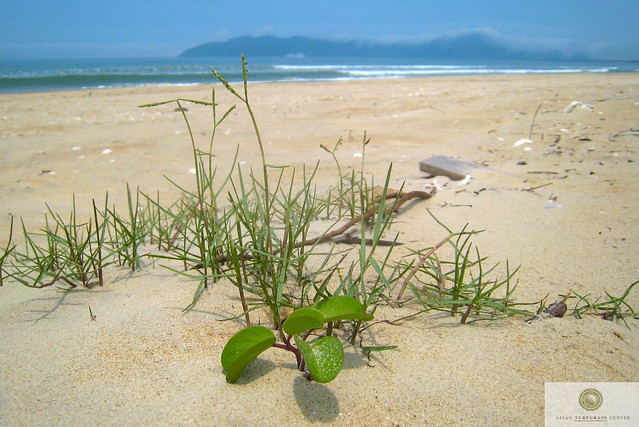
Seashore paspalum grows wild in tidal swamps and in intertidal zones. Which is exactly where I found it growing on the beach at Da Nang (below), in its natural environment, and free of diseases. But come in from the beach a short distance, where the high tide does not reach, and I found wiry Zoysia matrella growing in the dunes.

seashore paspalum on the seashore

There was brown patch on bermudagrass at Vietnam and bermudagrass white leaf, which I think is the most unsightly disease, on bermudagrass at Singapore and Vietnam.

Most of the diseases, you notice, were on seashore paspalum and bermudagrass. I saw two types of broadleaf carpetgrass this week, both free of any disease. This grass thrives in the umbrageous conditions so ubiquitous in tropical Southeast Asia, as does zoysiagrass.

And for those more interested in cool-season grasses, you probably read with some interest the post from Dr. Kerns and Dr. Soldat a few weeks ago about managing potassium on cool-season turf. I'm fascinated by the Park Grass experiment and its results showing that potassium and lime application cause a proliferation of dandelions and other weeds, and the most recent issue of the Green Section Record has an article with some insights into that experiment and how the results "carry lessons of high importance in the growing of golf turf."

Civitas Update....By Popular Demand


First, my apologies for the tardiness of this post. The pre-Thanksgiving travel crunch got the best of me last week, and of course I spent the entire weekend watching football and hockey, so I am just now getting caught up! Several people have asked what happened to the Civitas update, so here it is:

Civitas is a new product for disease and insect control in turfgrasses that was developed by Suncor, formerly known as PetroCanada. The active ingredient is mineral oil, otherwise known as 'horticultural oil', which has been used for management of plant pests for many years. It has just never been used in turf because of issues with phytotoxicity. However, Suncor developed a pigment product, called Harmonizer, that is mixed with Civitas to reduce the potential for phytotoxicity. The advantage of mineral oil as a fungicide is that it has very low environmental impacts due to its low toxicity and rapid breakdown in the environment.

Because it contains oil and pigment, Civitas has a very noticeable effect on the color and appearance of the turf. The Harmonizer pigment, depending on the application rate, is a very dark green, similar to that provided by an application of Triton Flo or Tartan. Some people have complained that transfer of the pigment to shoes and clothing has been a problem, but I haven't rolled around on our research plots yet to see how big of a problem that is.

The mineral oil component of Civitas also gives the turf a distinct greasy appearance, very similar to that caused by an application of a wetting agent like Cascade. This greasy appearance is most evident in the morning and persists for several days to a week after application. Because of these unique characteristics of Civitas, I suggest that people try it out on a nursery green or putting green before treating the whole course with it.

We've been evaluating Civitas for control of various turf diseases for three years now. For a summary of our previous results, please see my post from last year entitled Civitas shows promise for control of dollar spot and brown patch. Be sure to read the comments at the bottom provided by Wakar Uddin, Bruce Clarke, and others regarding their experiences with Civitas.

We continue to see similar results against dollar spot and brown patch in our trials. However, this year we ran into serious problems with phytotoxicity when Civitas and Harmonizer was tank-mixed with Daconil and Banner Maxx. The injury appeared very quickly after the first application in May and became more severe as time went on. As you can see in the graph to the left, it is also interesting to note that half rates of the mixture components did not reduce the amount of phytotoxicity observed. Based on this result, we definitely recommend that Civitas and Harmonizer should not be mixed with Daconil and Banner, or with other fungicides until we have the opportunity to evaluate more mixtures for their safety.

We haven't seen significant phytotoxicity from applications of Civitas and Harmonizer alone in our trials, but some users have reported injury during times of severe stress, with high temperatures consistently above 90F. It makes sense that it could create problems to coat the turf leaves in oil under these types of conditions.

To summarize, Civitas has good activity against several important turf diseases like dollar spot, brown patch, anthracnose, and leaf spot diseases. Although it does not provide acceptable control alone in most cases, my opinion is that it could be useful as part of a disease control program. Civitas and Harmonizer should not be mixed with other fungicides or applied to severely stressed turf, or severe injury could result. However, if you are interested in using products that pose less risk to environment, then Civitas is a good choice.

Honor (boscalid + pyraclostrobin)


Honor is a relatively new fungicide from BASF that contains the active ingredients boscalid and pyraclostrobin. Boscalid is the active ingredient in the excellent dollar spot fungicide Emerald and pyraclostrobin is the active ingredient in Insignia. Like Insignia, Honor will also be marketed under the umbrella of Intrinsic brand fungicides from BASF. If you have not heard of this, it basically states that pyraclostrobin may provide some additional plant health benefits aside from disease control. If you recall, John posted a blurb about our meeting at Farmlinks in October where we shown all the data behind the Intrinsic label. Although the data is a bit sketchy, there does appear to be some benefit to the plant. Before I go any further remember that these are fungicides and should only be used for disease control!

Disease Control
Honor is an excellent fungicide for broad spectrum disease control because it takes advantage of the dollar spot activity of boscalid and the brown patch and anthracnose activity of pyraclostrobin. Other diseases listed on the label are gray leaf spot, fairy ring, take-all patch and pink snow mold just to name a few. Therefore it could fit into a fungicide program for tees and greens at almost anytime of the year. However, I think it fits best during July or August when brown patch and anthracnose are likely to develop in the Midwest. Below are a few graphs highlighting the strengths of Honor against dollar spot. If you want to see how Honor's efficacy against anthracnose and brown patch compares to other fungicides, click on the diseases and you will see reports from Dr. Bruce Clarke at Rutgers University.

Curatively Honor (boscalid in particular) is slow to reduce the dollar spot epidemic, but overtime provides the best suppression. Preventatively Honor controls dollar spot well, but only provides acceptable control at the 1.1 oz rate under the pressure we experienced this year.

Summary
Honor is an excellent product especially for dollar spot and brown patch. I think the best fit for this particular product is during mid summer when dollar spot is still active and brown patch and anthracnose are just starting to get going. Plus pyraclostrobin also has activity against Pythium blight under lower pressures. Essentially this product could almost fit anywhere in a fungicide program in the Midwest.

New Granular Fungicides for Turf


Historically, fungicides on granular formulations have never been used frequently on turf. With the exception of late fall snow mold applications and damping off applications to the seedbed, there weren't many situations in which granular fungicides were recommended.

Two things were limiting the usefulness of granular fungicides: a limited selection of products and low-tech carriers that weren't very effective for foliar disease control. As a result, my standard recommendation has always been that if you want good disease control,  you should spray instead of spread. As an example, look at the tall fescue plots to the left that were both treated with triadimefon at the same rate of active ingredient per acre. Triadimefon is not a very effective brown patch fungicide to begin with, but the sprayable formulation (Bayleton) is much more effective that the granular formulation (Fungicide VII).

Things changed quickly, though, and today many more products are available on granular carriers, including recent products like Armada, Disarm, Heritage, and Headway. Several others are currently being tested as experimentals. Furthermore, these new products take advantage of modern granular formulation technology that makes them more effective against foliar diseases by increasing foliar absorption of the active ingredient.

We've evaluated a number of these new granular formulations, mostly against brown patch in tall fescue in a lawn care scenario. I will include a couple of examples here. I would summarize by saying this: these new granulars are more similar to their sprayable counterparts for brown patch control, but generally their efficacy is a erratic and they require more frequent applications. I still think that if you have the capability to spray, it's still better to spray. But these products provide more options to turf managers in situations where spray applications are not possible or practical.

Another possible advantage of a granular formulation is for control of root diseases like summer patch, spring dead spot, fairy ring, take-all patch, etc. To control these diseases most effectively, you obviously want the active ingredient to be in the root zone. With a granular, you can make the application and then water in later at your convenience, rather than having to worry about running the heads right behind the sprayer before it dries on the foliage. While we haven't tested these newer products against root diseases, we always used to see very effective spring dead spot control from granular formulations of Rubigan.

I'd like to hear some comments from our readers on this topic: What are the advantages and disadvantages of these granular formulations in your experience? If you are using these products, how and for what are you using them?

Storm damage, dollar spot


Strong storms caused some major tree damage last week. One golf course had some very large trees become uprooted, crashing down on across the fairways. Gusts of 90 mph were recorded (!)


Cooler weather!

A few days after the storm it was remarkably cool. After visiting my field plots on Tuesday morning, I needed some HOT tea instead of ICED tea.

The volume of turfgrass samples is way down this week, too. I hope everyone is enjoying the slight break from the stress.

To make up for the turf, I have had other types of samples including a smelly bag of pumpkin goo:

There wasn’t anything I could do with that one, other than hold my nose, throw it away, and ask for a new sample.

Dollar spot:

Dollar spot is on the rampage in some of our research plots, with infection centers coalescing and becoming quite sunken. The photo above shows infection in an untreated plot of a Cato-Crenshaw blend (very susceptible). In another week (or two…) I’ll try to summarize some of the data from our summer trials.

In the trial in cultivar A4, the dollar spot severity is hanging at about 10% (click to enlarge):

Brown patch:

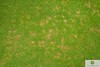
Brown patch is very active on the research greens at Rocky Ford:

The photo doesn’t quite do it justice–if you look closely (click to enlarge) you can see it better.

What else is going on out there?

Too bad we can’t eat nutsedge:

“sedges have edges” (note the triangle shape)

Too bad we can’t eat spurge, either

I guess if it came down to it, we could eat this guy:

Deep fried, crunchy. Lots of protein.


Related Posts with Thumbnails