

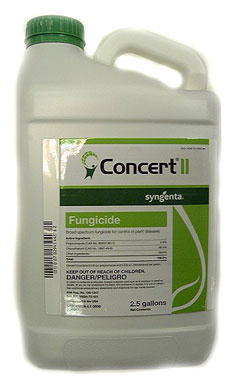
Research results with Concert:
Below are the results of some research findings from Penn State and Connecticut.

 Anthracnose basal rot is another disease where various studies have been conducted. In our studies at Penn State, Concert looks good and comparable to similar fungicides. To the left you will see a fungicide study conducted by
 Johnny 5 Dr. Inguagiato of UConn. I highlight this study because of the slight benefit that Concert provides when compared to the individual components. The 5.0 fl oz rate of Concert is equivalent to 3.0 oz of Daconil Ultrex and 1.1 fl oz of Banner MAXX for reference. In most of my studies, Concert has been included as part of a full rotational program. This is a good practice in general when dealing with season long applications of a DMI.
You can read the full research reports here:
Inguagiato, J.C., R. Blake and J.E. Kaminski, 2010. Preventive anthrancose control in putting green turf with various fungicides.
Kaminski, J.E. and T. Lulis. 2009. Impact of fungicides on teh control of anthracnose basal rot, turfgrass quality and algae on a golf course putting green.
What Syngenta said (slideshow):
Below are the results of some research findings from Penn State and Connecticut.
Disease suppression:

Brown patch suppression with Concert was excellent in a trial conducted in 2010 and this holds up with what has been seen in other trials that we have conducted. Treatments were applied on a 14-day interval, which may be improved with the use of a QoI which have excellent brown patch suppression. A benefit of this combination (chlorothalonil + propiconazole) would be the efficacy on dollar spot. Although I didn't have any data pulled together for Concert, the use of these two active ingredients have shown excellent suppression of dollar spot in past studies.

Quality/Injury:

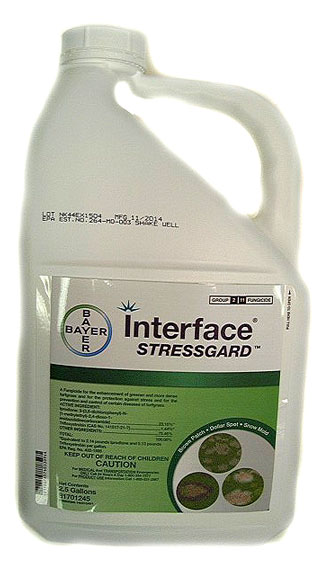
 One of the things that is worth pointing out is that these field studies are done to determine disease control with single products. Due to this fact, most of our studies are carried out in a manner that results in repeated applications of products that would otherwise not be sprayed that often. So it is not uncommon for injury to appear in our studies. Having said that, I found that the differences in injury among studies can often vary as was the case in two separate studies conducted at Penn State and UConn. In the Penn State study, no differences were observed between any fungicide and the untreated control, but there was a separation among fungicides. Namely, those products that contained the pigment in StressGard had improved quality relative to plots receiving Concert.
On the other hand, field studies at Connecticut showed significant injury from repeated applications of other fungicides including Triton (a DMI) and Reserve (DMI + chlorothalonil). Injury was observed within the plots treated with Concert, but the phytotoxicity was not different from the untreated control. No injury was observed when either of the actives in Concert were used along. So I guess the lesson here is that perhaps Mr. Hoff is correct and the new formulations developed during the creation of the "Pre-Mix" packages do influence different aspects of the product.

 One of the things that is worth pointing out is that these field studies are done to determine disease control with single products. Due to this fact, most of our studies are carried out in a manner that results in repeated applications of products that would otherwise not be sprayed that often. So it is not uncommon for injury to appear in our studies. Having said that, I found that the differences in injury among studies can often vary as was the case in two separate studies conducted at Penn State and UConn. In the Penn State study, no differences were observed between any fungicide and the untreated control, but there was a separation among fungicides. Namely, those products that contained the pigment in StressGard had improved quality relative to plots receiving Concert.
 On the other hand, field studies at Connecticut showed significant injury from repeated applications of other fungicides including Triton (a DMI) and Reserve (DMI + chlorothalonil). Injury was observed within the plots treated with Concert, but the phytotoxicity was not different from the untreated control. No injury was observed when either of the actives in Concert were used along. So I guess the lesson here is that perhaps Mr. Hoff is correct and the new formulations developed during the creation of the "Pre-Mix" packages do influence different aspects of the product.
You can read the full research reports here:
Inguagiato, J.C., R. Blake and J.E. Kaminski, 2010. Preventive anthrancose control in putting green turf with various fungicides.
Kaminski, J.E. and T. Lulis. 2009. Impact of fungicides on teh control of anthracnose basal rot, turfgrass quality and algae on a golf course putting green.
What Syngenta said (slideshow):
Concluding thoughts:
Concert is an effective fungicide against a wide array of turf diseases and can be used as an integral part of a disease resistance management strategy due to the inclusion of chlorothalonil. Diseases that it would be effective against would be brown patch, anthracnose, dollar spot, gray leaf spot and others. Repeated application of this product may be met with a couple of problems. First, seasonal use rates of chlorothalonil should be closely watched. These tank mix partners can confuse or at least make it more difficult to figure out how much actual active you have put out, especially when using different products all containing chlorothalonil. Additionally, the repeated use of any of the DMI's should be avoided due to potential phytotoxicity issues. Most of the research protocols that I have seen have been built with Concert in mind as a component of an overall fungicide program. Golf course superintendents should develop similar programs for their golf courses that target the primary problems they are facing. In the right situation, Concert can be an effective product in a sound program.
Download the Concert Label