Custom Search

Instrata (Chlorothalonil + Propiconazole + Fludioxonil)


Instrata is another fungicide that combines different active ingredients into a single product. Instrata has chlorothalonil (Daconil and many others), propiconazole (Banner MAXX and others) and fludioxonil (Medallion). Instrata quickly became the gold standard for snow mold control in northern climates like the Upper Midwest. Interestedly the formulation of this product combined suspended particles with a microemulsion that Syngenta calls a suspomicroemulsion. I really don't know what that means for golf course superintendents, but you have to admit it sounds cool! All kidding aside, we typically suggest that active ingredients should be mixed in order to achieve acceptable snow mold control. With Instrata you have three active ingredients that when combined do provided excellent snow mold control. Chlorothalonil is a contact fungicide that has activity on all three snow mold pathogens (Microdochium nivale, Typhula incarnata and Typhula ishikariensis), but is strongest on M. nivale and T. incarnata. Propiconazole is a DMI fungicide, which are known to have excellent activity on T. ishikariensis and fludioxonil seems to have activity on all three snow mold pathogens too.

For those who manage golf courses in areas that receive intense snow cover will likely experience all three snow mold pathogens at one time or another. I think the reason Instrata is a successful fungicide for snow mold control is golf course superintendents don't have to worry about predicting the weather because all the product works on all three snow mold pathogens. With respect to efficacy of Instrata, I have posted a few figures highlighting how well this product works. We do see breakthrough at our site in the UP, which has intense snow mold pressure. Yet, for the last two years we observed that 70 % of the products break down under that pressure. Even under that pressure, a single application of Instrata keeps disease severity levels between 15 and 40 %. Anyone that experiences such snow mold pressure should make two applications for snow mold and we observed that two applications of Instrata at 5.5 oz worked better than a single late application of Instrata at 11 oz at our UP site. For most golf course superintendents however, the 9.3 oz rate will work beautifully! A word of caution about the product, do not skimp on the rate in areas of high snow mold pressure. We have observed that reducing the rate to 5.5 oz in some environments may result in significant failure.


In summary, Instrata is an excellent combination fungicide for controlling snow mold diseases. It also has activity on other diseases too, which is obvious based on the active ingredients in the product. Instrata is an excellent choice for putting greens and tees and if the budget allows high value approaches and maybe even fairways. If you are interested in this product and have not used it before check out the label and Syngenta's website for more information.

New Granular Fungicides for Turf


Historically, fungicides on granular formulations have never been used frequently on turf. With the exception of late fall snow mold applications and damping off applications to the seedbed, there weren't many situations in which granular fungicides were recommended.

Two things were limiting the usefulness of granular fungicides: a limited selection of products and low-tech carriers that weren't very effective for foliar disease control. As a result, my standard recommendation has always been that if you want good disease control,  you should spray instead of spread. As an example, look at the tall fescue plots to the left that were both treated with triadimefon at the same rate of active ingredient per acre. Triadimefon is not a very effective brown patch fungicide to begin with, but the sprayable formulation (Bayleton) is much more effective that the granular formulation (Fungicide VII).

Things changed quickly, though, and today many more products are available on granular carriers, including recent products like Armada, Disarm, Heritage, and Headway. Several others are currently being tested as experimentals. Furthermore, these new products take advantage of modern granular formulation technology that makes them more effective against foliar diseases by increasing foliar absorption of the active ingredient.

We've evaluated a number of these new granular formulations, mostly against brown patch in tall fescue in a lawn care scenario. I will include a couple of examples here. I would summarize by saying this: these new granulars are more similar to their sprayable counterparts for brown patch control, but generally their efficacy is a erratic and they require more frequent applications. I still think that if you have the capability to spray, it's still better to spray. But these products provide more options to turf managers in situations where spray applications are not possible or practical.

Another possible advantage of a granular formulation is for control of root diseases like summer patch, spring dead spot, fairy ring, take-all patch, etc. To control these diseases most effectively, you obviously want the active ingredient to be in the root zone. With a granular, you can make the application and then water in later at your convenience, rather than having to worry about running the heads right behind the sprayer before it dries on the foliage. While we haven't tested these newer products against root diseases, we always used to see very effective spring dead spot control from granular formulations of Rubigan.

I'd like to hear some comments from our readers on this topic: What are the advantages and disadvantages of these granular formulations in your experience? If you are using these products, how and for what are you using them?

Interface (Iprodione + Trifloxystrobin)


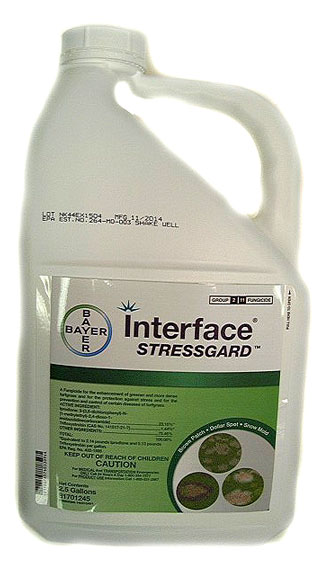
Interface® is a relatively new Pre-Mix fungicide from Bayer Environmental Science and contains the two active ingredients iprodione (found in Chipco 26GT and others) and trifloxystrobin (Compass). While some of us have worked with the individual products for many years, it is only recently that I (and probably many others) have worked with the Pre-Mix version. Below you will find data from a recent fungicide trial with Interface®, a statement from Bayer on the strengths of the product and my concluding thoughts.

2010 Dollar Spot Trial and Turfgrass Quality:
Dollar spot. Active dollar spot symptoms began to appear shortly after treatments were initiated on 24 May.  Disease activity began to increase rapidly in June and when plots were rated on 14 Jun, and average of 34 to 39 infection centers (IC) were present within the untreated control plots (data not shown).  Dollar spot was suppressed on most rating dates during periods in which treatments were applied and generally were very low (0-2 IC) within 7 days following application and low to moderate (1-14 IC or 0.1-2.9%) 2 to 3 weeks after the last application.  On 13 Aug (17 days after the last application), dollar spot was completely suppressed in plots treated with Interface at rates ≥ 4.0 fl oz. Moderate suppression (2.0% disease) was observed within plots treated with Interface (3.0 fl oz) and Iprodione Pro. Although disease pressure started to increase approximately 3 weeks after the last application, significant reductions in dollar spot were still observed within plots treated with the higher rates of Interface into early September.

Turfgrass color. Turfgrass color (which excluded the impact of disease within each plot) was rated on 27 Jul (2 weeks after the third application). All plots treated with Interface and Tartan had improved color when compared to the untreated plots and those treated with Iprodione Pro.

Overall, dollar spot suppression within this trial was good to excellent with products containing Iprodione.  A slight rate effect with Interface treatments was observed.  Moderate suppression of dollar spot was achieved within plots treated with Tartan.  This is likely due to a known reduced sensitivity to fungicides within the DMI chemistry at this site.  All treatments containing the green pigment StressGard improved turfgrass color and quality throughout the study.

What Bayer had to say:
Interface® is the non-DMI of choice 
  • Consistent Disease Control
  • Turf Safety
  • Turf Quality
  • Disease Control
    • Best Leaf Spot Product
    • Great Dollar Spot and Brown Patch Performance
    • Great rotation product for Anthracnose Programs (including Basal)
    • Top Snow Mold control for < 150 days snow cover with earlier green up in the spring
Concluding thoughts:
Interface® is a strong fungicide for certain foliar diseases found during the summer months, specifically brown patch and dollar spot. Although we have not conducted studies specifically for brown patch, all strobilurins (including Compass) generally provide excellent suppression of this disease. Coupled with iprodione, Interface® is able to target both foliar diseases. This may be particularly useful in situations where insensitivity to the DMI fungicides for dollar spot is present as is the case at our research facility at Penn State. Although thought of as a "great rotation product for anthracnose programs", the use of Interface for the suppression of this disease may be limited. In our previous trials, suppression of anthracnose with iprodione has been moderate to poor and resistance issues with the strobilurin fungicides against anthracnose may all but negate its usefulness for this disease. Where resistance is NOT a problem, the strobilurins work very well.  Unfortunately, where these products have been used extensively for anthracnose suppression they are likely not useful anymore.

An added strength of Interface® is the addition of the StressGard technology. While I still don't know exactly how and why this provides improved plant health, the benefits of this additive are consistently observed in the improved turfgrass quality and color following application. 

Overall, I think that the combination product will be useful for controlling common turfgrass diseases during the summer months and will be effective in a rotational program. In situations where its use is effective against anthracnose and/or other diseases where known resistance may occur, it will be important to rotate fungicides from other chemical classes. Although this is not specifically related just to Interface, the Pre-Mix packaging of fungicides is becoming more common. A primary concern of mine with this is the potential overuse of certain fungicides where resistance is known to develop relatively rapidly (namely the strobilurins). Golf course superintendents should pay close attention to the active ingredients within the various Pre-Mix products and make efforts to truly rotate chemistry when developing their seasonal fungicide programs.

Download the pdf Fungicide Label.

Theme Week: "New" Fungicide Reviews


As a way to increase our postings during the winter months and keep providing relevant information to golf course superintendents, the Turf Disease Blog has decided to do a series of "Theme" weeks in which each blogger tackles a topic within the theme.  Thanks to Dr. Tredway for coming up with the idea.

Our first theme is going to focus on reviews of individual fungicides that are relatively new to the market. Each blogger has simply been told what fungicide to review and what day to post. Other than that, there are no restrictions or guidelines as to the material presented.  I suspect that you will see a little data and some decent summaries of the strengths, weaknesses and potential issues with each fungicide.

"New" Fungicide Reviews*

Monday 11/15: Interface
Wednesday 11/17: Instrata
Thursday 11/18: Endorse/Affirm
Friday 11/19: Reserve
Monday 11/22: Concert
Tuesday 11/23: Civitas
Wednesday 11/24: Honor
Thursday: 11/25: Renown (posted 11/28)
Friday 11/26: Trinity/Triton
*Reviews of individual fungicides by authors of this blog do not endorse, promote, or in any way recommend the use of specific products. Reviews are based on public information, personal experience or company input. If you have questions or comments about the individual reviews, we encourage you to share your thoughts in the comments section of the individual blog post. Your question or comment may be something that provides valuable information to others reading the blog. Authors will do their best to respond to questions/comments in a timely fashion!

If you are interested in learning more about some of the fungicides that are now available, check back over the next two weeks.  Yes, I said TWO WEEKS...the idea was so good and there were so many fungicides that we decided to have everyone tackle two products and post through the week of Thanksgiving...sorry Megan!

Your Input Requested!
Do you have an idea for an upcoming "Theme Week"? If so, then leave us a comment below OR on the Facebook page. We can't promise we will get to them all, but we will do our best to address your concerns during the winter months while disease pressure is low!

Results from one of our summer trials


Hi,
I'm home sick today. Yesterday I woke up with a pounding headache and major fatigue, as in, sometimes it seemed like too much work just to roll over. I'm not sure what is the causal agent, or is it environmental stress? I don't think it's bacterial wilt. Either way, I feel like crap. Yesterday I stayed home and out-napped the cat, who is a champion napper, and accomplished very little.


After another nap-off this morning (I defeated the cat once again), I was feeling good enough to sit at the computer, but not good enough to haul my sorry butt to campus. So, I'm doing what bloggers all over the world do... sitting at my laptop in my jammies and slippers, with my hair still in bed-head mode. At least I'm not in my parents' basement.

SUMMER TRIAL INFO

I thought I’d share some results from one of our summer trials in creeping bentgrass. The study was conducted in a stand of A4 on a sand-based green. There were four “program” treatments that rotated through different products. Those details can be viewed at a higher zoom by clicking on the boxes below, and hit the back button to return to the main article:

.

.

.

Now, here’s a list that shows all the treatments. The right-hand column shows the turfgrass quality as averaged across the whole season. Turf quality was based on color, density, uniformity, etc, but did NOT include disease (since disease is noted separately). 9 = optimum quality, 6 = minimum acceptable.

As noted in the table, programs 3 and 4 had some slight negative quality effects, presumably due to some growth regulating effects of the DMI fungicides that were applied in late June. The effects were subtle, and they don’t come across very well in a photo:

… but, there really was a slight off-color to those plots on one or two dates.
When it comes to dollar spot control, except for some trace amounts early on, the treatments all pretty much knocked disease down to zero compared to a peak of about 10% in the untreated plots. (click to zoom)


Hey, I just heard the garage door... I think my sweetie has come home for lunch. I bet he'll make some soup for me!

.
.
.
.
Related Posts with Thumbnails