Custom Search
Showing posts with label algae. Show all posts

Slime, Goo, and Caviar


Wet Wet Wet


That is the name of the game this week. I’ve seen some pretty amazing photos of flooding at some Kansas City area golf courses, where the fairways were more like rivers, and the putting greens like islands. At one course they’d had something like 13 inches of rain in less than a week. Right here in the Little Apple we had streets and cars underwater yesterday as Wildcat Creek overflowed its banks.


As part of the rain and storms, the Heart of America Golf Course Superintendent’s Association (HAGCSA) research and scholarship tournament was rained out this week. The HAGCSA has been a great supporter of the K-State turf program, and though the tourney was unfortunately canceled/postponed, I’d like to thank the organizers at Mission Hills Country Club, with superintendent Brad Gray, for their efforts. I hope they can reschedule later this summer, as I know it is a fun event for everyone who participates.


Speaking of wet: Hot, humid weather is triggering more brown patch, such as these symptoms I saw this week:

brownpatch_bent

For more details on brown patch you can visit this site:

http://www.ksre.ksu.edu/library/plant2/ep146.pdf


Now, on to the slime molds, algae, and a curious case of a mycorrhiza-gone-bad


Slime

The wet conditions are triggering slime mold activity. No, those are not muddy footprints. It is slime mold in fairway-height zoysia.

gray_slime_mold_zoysia_4

gray_slime_mold_zoysia_3

The following two images were sent in by Chuck Otte, Agriculture and Natural Resources Agent for Geary County. This is a slime mold that has a stalk, leading to a pretty striking appearance.

10 Turf_Geary Co_Printy_chuckotte

10 Turf_Geary Co_Printychuckotte


Now, let’s move on to goo.

This photo was taken by my graduate student Ken Obasa, and I showed it a week or two ago.

algae_ken_colbert

The green goo was taking over bare-dirt spots near a putting green.

Here’s a close-up

gooey_algae_2

But, new THIS week, here it is in the microscope, making chains of cells, like a string of pearls:

chains_maybe_nostoc

Now, I’m not a scholar of algae (a phycologist), and I know it is dangerous to base a diagnosis based on photos, but a little searching makes me think that our algae may be in a group called Nostoc, based on some information I found here:

http://silicasecchidisk.conncoll.edu/LucidKeys/Carolina_Key/html/Nostoc_Main.html

This is one part of a group of organisms called blue-green algae. This algae was taking over the already-bare spots, and that generally is the case. The best dose for algae is to have a healthy stand of turf.

And, finally… Caviar. (????)

Symptom: small, lime-green areas, turning tan, on creeping bentgrass greens.

maynard

In the sample, some small round structures were visible in the turf. It kind of looked like a spoonful of caviar, not that I’ve ever eaten caviar. Upon higher magnification they appeared to be a mycorrhizal fungus. (You should be able to click to enlarge)

Slide1

Slide2

Slide3

This was a new phenomenon for me. But, apparently, mycorrhizal fungi (this one is probably in the genus Glomus) can sometimes go awry. Normally, mycorrhizae are beneficial, helping the plant take up nutrients. But in some cases, such as when nutrients are imbalanced, the turf is stressed, etc, the mycorrhiza takes more than it contributes to the partnership and ends up acting as a parasite.

There was an outbreak of this a few years ago in Chicago, all on greens that had recently been renovated. In that case, most of the spots disappeared on their own. I heard from Derek Settle of the Chicago District Golf Association that some courses had success with thiophanate-methyl, a disintestant-type product called Consan, or plugging out affected areas. Frank and John mentioned that they have seen or heard of this as well. For, me, it was my first time seeing Glomus-Gone-Wild.

The Blob and Borat


Hi,

I'm posting a day early since I'm leaving town tomorrow. Frank and I have known each other a long time, and I'm sure he'll forgive me. Plus, he knows I have more grad-school era blackmail photos of him than he does of me.

It's actually been a fairly quiet week for turf diseases. Dollar spot is continuing to be active and so is large patch.

One weird item from the week is the big green blob.


Here's a shot of it in the field, by my grad student Ken Obasa:


This seems to be some type of algae that is more robust than your typical algae. At the course, the crew said that it is plump and green in the morning, then turns black and dry in the afternoon. I don't think they should let anyone near it alone... that green blob looks hungry to me!


Our lightning adventures continue.

Steve Wilson, Superintendent at Meadowbrook Golf & Country Club in Prairie Village, KS, sent in this photo:

Steve_Wilson_tree

Steve said:

“I’ve attached a picture of a tree on our #5 hole that got struck by lightning about 5pm this past Wednesday. The strike blew all the bark off the trunk and split the tree. There is
an irrigation satellite about 10 feet away from this tree that suffered damage and all the sprinklers (72) on this satellite turned on at the same time when the strike occurred (hence the irrigation running in the background).”

Thanks Steve for sharing the picture and details.


What is this:

tajikistan

It is not West Virginia

I’m headed there for a few days, starting tomorrow.

Hints:

1) It’s a ‘Stan

2) It is a former member of the USSR

3) The main language is one of the modern variants of Persian. That is, it is NOT derived from Turkic origins.

4) More than fifty percent of the country is over 9,800 ft above sea level

Ideas?

The answer is Tajikistan. It’s in yellow.

caucia

I’m a new member of a project sponsored by the US Agency for International Development (US AID) for integrated pest management of potato, tomato, and wheat (I work on some food crops in addition to turf & ornamentals). The project has components in Tajikistan, Kyrgyzstan, and Uzbekistan. For information on the first 5 years of the project you can check out this page:

http://www.ipm.msu.edu/central-asia.htm

I’ll be joining the entomologists who carried out the first 5 years of the project to start a new 5-year project that also includes plant pathology. As one example, the project will identify 3 graduate students from those countries to come spend some time in the US to receive training.

FAQ:

What is the time difference? 10 hours

How do you get there? Kansas City > Chicago > Paris > Istanbul > Dushanbe (capital) on American Airlines, Air France, Turkish Airlines, and then some on Delta on the return

How long does that take? I really don’t want to know. About 30 hours. I’ll be trying to catch some sleep on planes and during a 6.5 hour stopover at Istanbul.

Have you traveled overseas before? In grad school I worked in Australia 3 times, for about 2 months each time. And, I did the backpack around Europe thing. So, I’m no stranger to jet lag. But, central Asia is an order of magnitude more adventurous than any prior overseas travel.

Do you have to wear anything special? Nothing too unusual. I have some long skirts, modest shirts, and I do have a headscarf if a situation arises where I need it though in Dushanbe it is not too common.

What language do they speak? Tajik. And, a lot of people speak Russian from the USSR days. Tajik is written in the Cyrillic (Russian) alphabet.

Is that where “Borat” is from? No, that’s Kazakhstan.


Pythium, algae, brown patch, flooding and more


I returned from the International Turfgrass Society meetings on Friday afternoon and was greeted to a slew of new diseases in the region. At the research facility, algae and brown patch were taking off due to the recent rains and high temperatures. The recent rains were not without their own problems as it caused major flooding at various golf courses in the region. Most notably, Merion Golf Club had many bunkers wash out and even had holes under water for a period of time (Image of hole #11 fairway and green, courtesy Matt Shaffer). Also hanging on in many regions is the Type II fairy ring species on both putting greens and fairways. I have yet to see these rings collapse in the Northeast, but it is likely that some superintendents are dealing with more severe cases.

Dr. Landschoot indicated that Pythium blight was also active on his fine leaf fescue variety trials. Although I hadn't seen any Pythium around the facility, I did notice that half of my Kentucky bluegrass lawn was wiped out on the side of my house. This area receives little light or air movement and has a swale that carries the water from about 10 properties away from entering my basement!

Overall, I would say that this summer has been a cake walk as far as disease and heat problems are concerned. Although we are not completely out of the woods, we are getting close.

On the lookout...I have not heard any reports of gray leaf spot yet, but this is one disease that is likely just around the corner and preventive treatments should now be close or in place already depending on your location.

Do you have anything happening at your course worth sharing? If so, feel free to add your story to the comments section or send images to be included in a future posting!

OH! I almost forgot, everyone keep an eye out for Frank Wong's posting this week from the American Phytopathology Society Meetings in Portland. I hear they are seeing some interesting things in the streets of Portland this week!

Algae and Tri-Tip


Our weird weather patterns are continuing here in California with highs in the 60-80s in many coastal locations and lots of overcast days and June gloom in southern California.

Dollar spot, brown ring patch, rapid blight and fairy ring seem to be pretty active in the state and southern blight is starting to show up in parts of northern and central CA.


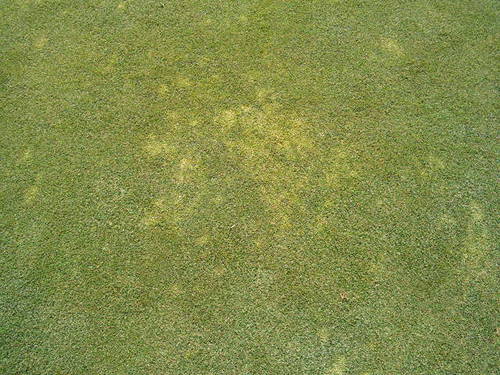
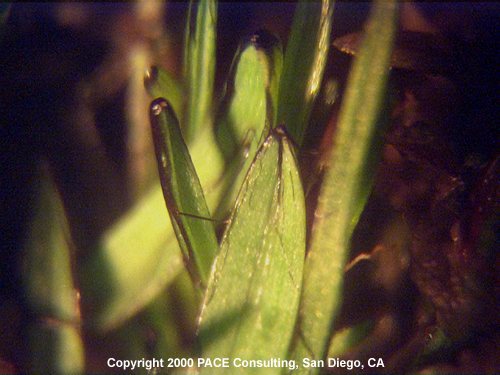
With the lack of the usual California sunshine, we are also starting to get a lot of algae samples coming into the diagnostic lab. Under cloudy conditions, Oscillatoria spp. of algae often develop on greens when the soil surface is wet for an extended period of time and often high thatch and organic matter make the problem worse. Algae can seal the soil surface reducing plant growth and some species of algae can produce a toxin that causes turf yellowing.


(photos used by permission, www.paceturf.org)

Improving surface drainage and increasing light exposure will help reduce the impact of algae as will certain fungicide applications. Chlorothalonil (Daconil), mancozeb (Fore) and hydrogen dioxide (ZeroTol) were shown to be very effective in reducing algae in UCR trials. Applications should be made 7 to 14 days apart to reduce the algae. However, if the surface moisture remains high, algae can often recolonize areas.

GCSA of Southern California Scholarship & Research Tournament
This last Monday, I had the pleasure to help out at GCSASC's S&R Tournament at Industry Hills Golf Course as many of our local superintendents played golf to raise money for southern California schools. Greg Fukumitsu (Syngenta Professional Products) drove his industrial-strength BBQ rig down from Ventura Co. to grill tri-tip and sausages for the players along side Dean Mosdell (Syngenta) and Mike Sommer (Simplot Partners). I have no idea what Greg's secret recipe is, but his tri-tip was as addicting as crack cocaine.

GCSASC also awarded three scholarships to some of our local students including Jerry Hernandez (College of the Desert), Brent Barnes (UC Riverside) and Marvin Seamus (Cal Poly Pomona).

I was very happy to have spent most of the day dishing out tri-tip, getting ice and driving VIPs like Jim "Speedy" Lipari and association manager Cyndy Neal around the course instead of looking at plugs of moldy turf. Thanks again to GCSASC for supporting research and education in California!
Related Posts with Thumbnails