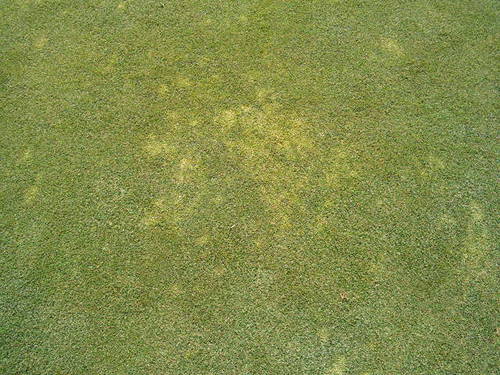


Anthracnose seems to be active - not massive death and destruction anywhere, but we're picking it up here and there in the diagnostic lab and through reports from superintendents in California.

Reddish-brown symptoms already kicking in on Poa at UCR
Our poa plots at UCR are already getting anthracnose so it's shaping up to be a good year for anthracnose experiments.
The 110th U.S. Open at Pebble Beach and a Pest You Might Not Know (& Don't Want to Have!)
Unless you've been hiding under a rock, you probably know that the 110th US Open is on at Pebble Beach. On TV, the weather looks awesome (clear sunny days) and the course is lookin' sweet.
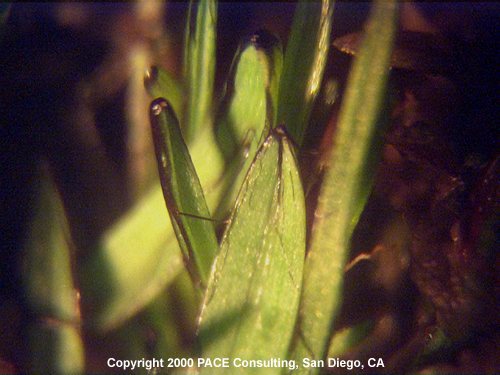
One problem that you won't be seeing on TV, but one that almost all of the superintendents in the Monterey and SF-Bay area with Poa greens battle is the Anguina gall nematode.

Galling on Poa annua caused by Anguina pacificae
It's a pretty unique Monterey and SF Bay area specific problem that's a pain in the fanny to manage.
Here's a great story from TurfNet about the nematode and how it affected decisions made for the upcoming 2012 Open at the Olympic Club in SF: http://www.turfnet.com/view_news.php?obj_id=448
Some shots of damage by Akoni Ganir (Cypress Point): http://turftime.blogspot.com/2009/12/things-that-kill-grass.html
and a USGA Green Section Pub on the problem: turf.lib.msu.edu/2000s/2005/050907.pdf
In any case, Chris Dalhamer and crew, and the army of volunteer superintendents out on the course are doing a fantastic job! Kudos to you guys and best of luck in the next few days!
Grilling (and Chilling) With GCSA of Southern California

GCSASC President Robert Hertzing (Lakeside GC), Pat Grodoville (Palos Verdes GC) and Fred Eckert (BASF) overlooking #12 at Palos Verdes GC.
Just a quick recap of the GCSA of Southern California's Scholarship and Research Tournament held last week at Palos Verdes Golf Club on June 7th. It was great to see all of the superintendents who came out to raise money for the universities and academic scholarships!
 I got to grill tri-tips all morning long with Greg Fukumitsu and Dean Mosdell from Syngenta Professional Products to feed all of the hungry superintendents and affilates who particpated in the tournament. I am convinced that I'd rather be grilling tri-tips for superintendents instead of saying "yep, you got Waitea" any day!
Thanks to course superintendent Pat Gradoville for hosting and to chapter manager Cyndy Neal for organizing the event!
Ok - until next week, signing off from the right coast.....