Custom Search
Showing posts with label brown ring patch. Show all posts

Beautiful Weather, Finally?


This spring has been one of the coolest and cloudiest on record. Just last week I was in Stevens Point, WI and soil temperatures barely reached 60 F. Still prime time for take-all patch and fairy ring preventative applications. To be honest not much is happening around the Upper Midwest. We have had reports of brown ring patch, but thats about it. Derek Settle at the CDGA has reported brown ring patch and a bit of dollar spot. We have seen and heard of multiple cases of creeping bentgrass turning red this spring. We think it is a combination of proxy/primo or trimmit + DMI fungicides for take-all/fairy ring + cool temperatures. The symptoms are typically seen on older leaves and we cannot find spores of any kind in the samples. An image of the symptoms we are seeing is above, sorry the image does not show the symptoms very well. If anyone has any thoughts on this matter they would be welcomed and appreciated!

Finally I thought I would reiterate a former post Lane wrote. He presented a succinct description of diseases that typically affect creeping bentgrass and annual bluegrass putting greens. There has been concern in the Midwest with the substantial amounts of rainfall we have received that Pythium root rot could be a problem. Yes Pythium root rot could occur at anytime as long as the soils are saturated, but considering creeping bentgrass and annual bluegrass grow well during the spring I rarely think of Pythium root rot as an issue. This brings me to another point Lane made in a previous post, is Pythium root rot a disease. I think it is a disease because we would not see symptoms characteristic of root rot if the pathogens were not present. Keep in mind though once/if summer rolls in and we continue to receive significant rainfall, then we might see issues with this disease. I am not saying that fungicides are not warranted, but I do think it is unlikely that Pythium root rot would/did occur this spring in the Midwest.

Things are picking up FAST!


Yesterday (this was meant for yesterday, but new disease activity today [Tuesday] has me posting a day late) I had the pleasure of hanging out at the Rutger's Annual Golf Classic which raises funds for their research program. I even got to play a little golf with our Midwest blogger Jim Kerns. Having left State College on Sunday and not really seeing much of anything on the disease front at Penn State, I was excited to find out if there were any actual turf diseases in the field...we hit the jackpot in North Jersey.

While certain diseases like anthracnose, leaf spot and brown ring patch were very active, I was surprised to see active dollar spot and RECOVERING brown patch (looked like it was active about a week ago or so). I think that things have been some moist and humid that everything is just taking off at this point. This would definitely be the earliest I have ever seen brown patch in the mid-Atlantic region and is in general pretty early for dollar spot as well.

Thatch collapse
This morning I headed into the Valentine research facility in State College and was surprised to see a LOT of disease activity there as well. We still don't have any dollar spot and brown patch is definitely a ways off for us, but there are several things going on. First, seedheads are in full force right now and we will be rating our plots over the next few weeks to see what worked and at what timing. As for diseases we are seeing: red thread, leaf spot, brown ring patch (images below, we are confirming by isolation...update to come), thatch collapse (see next month's GCM issue), Microdochium patch, and probably something else that I am forgetting.


So diseases are here or just around the corner...we could be in for another long year.

Waitea Patch trials give me the Hives


Let's try something different this week!

Shot on an iPhone4 and edited with iMovie.


Fungicide Review: Polyoxin D


Polyoxin-D: Mother Nature’s gift for fighting Rhizoctonias (and some other important diseases).

Polyoxin-D zinc salt is the active ingredient in two turfgrass fungicides: Endorse (Arysta) and Affirm (Cleary Chemical). There’s been some switching around of names and products since 2009 (as discussed last year) when Arysta LifeScience took back the distribution rights for the 2.5% WP formulation and Cleary’s introduced Affirm, a 11.3% WDG formulation, that contained the same active ingredient. Either way, both formulations have the same range of disease control and I haven’t seen any data so far to suggest that the two formulations have any significant differences in disease control between them. Polyoxin D is classified as a FRAC Group 19 fungicide (polyoxin antibiotics) and presently, only polyoxin D is registered as a turf fungicide in the U.S. (Image to the right taken from alanwood.net)

There are a number of other polyoxins out there (polyoxin A, polyoxin B,…polyoxin J, etc.), and they all share a common “ancestry” as far as being discovered as metabolites of Streptomyces bacteria (which are commonly called Actinomycetes). Streptomyces are typically soil inhabiting bacteria and are potent producers of some very important anti-bacterial and anti-fungal antibiotics. Interestingly, antibiotics derived from Streptomyces species account for two-thirds of our commercially available antibiotics including streptomycin, chloramphenicol, tetracycline and vancomycin (anti-bacterials) and nystatin and amphotericin B (anti-fungals).

Polyoxin D was discovered in 1965 as a fermentation product of Streptomyces cacoi var. asoensis (Suzuki et al 1965 Journal of Antibiotics Ser. A), so interestingly, this molecule has been around for a long time! Commercial fungicides containing polyoxin D utilize this active ingredient in the form of a zinc salt. Why, may you ask? Because the polyoxin D molecule is extremely water soluble and it would wash off of plant surfaces easily; the zinc salt form of polyoxin D is much more stable and enhances the longevity of the fungicide on the plant surface.

Biochemically, polyoxin D inhibits the formation of chitin, which is the main component of the cell walls of true fungi (Ascomycetes, Basidiomycetes, etc.). You can see from the photo here (taken from Endo et al. Journal of Bacteriology 1970), that fungal cells treated with polyoxin D (top photo) are unable to make functional cell walls and thus can’t function normally like the untreated ones (bottom photo).

Since Oomycetes like Pythium don’t use chitin in their cell walls, polyoxin D won’t affect these “water mold” type fungi. Polyoxin D is considered a local penetrant fungicide, and does not translocate easily upwards in plants like some other systemic fungicides, so coverage is important when applying these.

The earliest use of polyoxin D was for the control of rice sheath blight (Rhizoctonia solani) in Japan back in the 1970s. Not surprisingly, for turf diseases, Endorse and Affirm would be considered strongest against Rhizoctonia diseases like brown patch, large patch and yellow patch and the Rhizoctonia-like Waitea diseases like brown ring patch and leaf and sheath spot.

In a large patch trial we did in 2008, you can see that Endorse was very good in controlling large patch.

Applications made 16 Apr and 6 May to bermudagrass

In a brown ring patch trial also conducted in 2008, Endorse provided some of the quickest control of the disease, but didn’t have as much residual as some other treatments. We suggest tank mixing Endorse or Affirm with another fungicide like a DMI (Banner MAXX, Tourney, Triton or Torque) to get good knock down and added residual.


One curative application made on 26 Apr

In our California trials, we’ve seen it been pretty good against anthracnose and although other materials seemed to be better, Endorse and Affirm could certainly be added into the summer rotation.


Six applications total from Jun to Aug, 2005 data

Other diseases on the labels include pink and gray snow molds (it seems like they are best tank mixed with another fungicide for the best control, but ask Jim about that one), red thread, leaf spots, gray leaf spot, and fairy ring.

Endorse looked pretty good vs. fairy ring in trials conducted by myself and Mike Fidanza :www.gcsaa.org/gcm/2007/may/pdfs/treatingFR.pdf

However, I can’t say that I’d recommend polyoxin D by itself for gray leaf spot, I just haven’t seen enough data to say it’s a good choice for this disease when other fungicides are available.

OK – that’s enough geeking out for tonight – until next week, signing off from the Right Coast….

Cooler temperature are here to stay.


It's been a while since I last posted and temperatures during this past month have been highly variable.  Warmer to actual hot temperatures were observed in many parts of the Northeast over the past week, but the forecast for the upcoming 10 days looks like cooler temperatures may be here to stay.

With these cooler temperatures will still come the potential for disease activity.  Over the past couple of weeks, dollar spot has made it's typical late season resurgence and we are probably not out of the water completely as far as this disease goes.  A couple of year's ago when warm temperatures extended into December and January in the Washington, D.C. area, dollar spot activity continued through the end of the calendar year.  However, the only real problems that I have seen showing up at this point are brown ring patch and yellow tuft.  Brown ring patch, which has been described in detail in previous posts (click here to see all related BRP posts) will likely continue with the predicted weather conditions.  Yellow tuft, not really a major problem, has shown up in areas that have poor drainage issues or in areas received heavy rains.  For those of you not familiar with the disease, symptoms are small yellow spots (about the size of a US quarter) which generally appear in areas where water can sit for a period of time.  To diagnose this disease, you can simply "tease" out the yellow tufted plants and look for the excessive tillering of the plant (photo below).

One thing that superintendents further North should really be on the lookout for now is the development of Microdochium patch (aka Fusarium patch).  The cool wet weather we are about to head into for the season is PERFECT for the development of Microdochium patch. There are many fungicides effective for this disease, but the combination of chlorothalonil + iprodione has always been a go-to for many of the superintendents in the New England region where chronic problems with this disease occur. This would also be a great tank-mix for our international readers, particularly those in the UK where this is the primary disease.

As with Megan, I hope to be posting more updates in the coming months.  This will likely focus on some research results from fungicide evaluations conducted this summer and also on the numerous conferences that many of us will be attending between now and March. If you have anything specific that you would like to hear about, please feel free to leave a comment below.  If I have any information relevant to the topic, I will make it the focus of a future post.

Lower temps may mean MORE turf diseases


This past week was busy for the turf pathologists around the country. I was very busy dealing with samples, our Research Field Day, and scathing emails regarding my post about bacterial wilt being BS and the Wall Street Journal Article.  I should definitely clarify (which I attempted to do in a comment to my original post) what I was talking about.  Here are a couple of comments that I received about these posts.

Email received about my post about the WSJ article:
"I recently read your blog titled “Melting turf and Turf Pathology meeting”.  And I was a little confused on some of your statements.  In the blog you stated your read the article in the Wall Street Journal.  Then you later state some diagnosis was BS.  Were your referring to something in the WSJ article was BS or was that an entirely different matter?  I am not questioning you, just trying to clarify what you meant because when I read your blog it came across you were saying the WSJ article was BS.  Which I hope wasn’t the case as that article has definitely helped me in my current situation."
I thought that the WSJ article was a great one and anytime the popular press covers an issue like turfgrass being hard to maintain due to the heat of the summer, I think that it is good for superintendents.  The issue related to BW was totally separate and had nothing to do with the WSJ article.  In my follow up to the email I also mentioned some errors in the article, but when I went back and read the article I realized I was talking about an article posted by Lane in a previous post where they called Pythium a bacteria.

Email received about my post of bacterial wilt being BS:
"Wow John, doesn’t sound to Scientific! Better start doing some research to make a real Diagnosis.  I was at APS also, you should have come by if you needed validation. [sentence omitted for privacy]
Explain the Etiolation please, sounds like Penn State might be rubbing off on you. Lane still can’t explain why healthy plugs die in three to five days. If he has to you please let me know. Heat and Humidity right???? Hope you aren’t teaching that."
So my response to this was probably a little harsher than it should have been and I realize that superintendents are under a lot of stress.  I also don't take anything personally and do my best to try to help any way I can...and yes, I love Penn State (this happened long before I took the job here though). However, this brought up a good point about the whole bacteria wilt issue.  I am not saying that a potential bacterial wilt problem doesn't exist, however, I feel that many diagnosticians and superintendents are using this as a go-to answer for problems that can't be explained. In many cases (generally about 35-50% of our samples annually), thinning and/or dead turf can not be attributed to a biological agent.  That doesn't mean that something can't be done, it just means that spraying a fungicide is not going to be the answer. In many cases, the issues are related to shade, poor air movement, poor drainage, etc. Addressing these issues often times fixes the declining turf problem. A problem with many diagnostic labs is that they know diseases and diseases only...finding a lab that knows something about turf and agronomics is important. Click here to see all the comments regarding diagnostic labs.

Dollar spot was raging this morning in State College, PA
On to the disease issues:
Temperatures are dropping around the mid-Atlantic and Northeastern US, but this may actually bring more diseases than less.  At the turf plots this morning at Penn State, we had active mycelium on both dollar spot and brown patch, algae raging, anthracnose active, red thread in low fertility areas, and probably other things that I didn't have a chance to check out.  I also received an email while typing that a superintendent in the area may have a new outbreak of brown ring patch on their greens.  Temps in State College were relatively low this weekend, but RH was very high and things exploded last night.  I am sure that many of you are experiencing the same thing in your region.

Here is the 10-day forecast for some cities around the region:

Albany, NY: mid 70's to mid 80's
Boston: Low to mid 80's with temps dipping to 77oF on Thursday!
Philadelphia: ~90oF for the next two days then mid 80's
Pittsburgh, PA: 77-85 with nighttime temps in the mid 60's/low 70's
New York: Temps ranging from 80 to 91oF
Washington, D.C.: Fluctuating between mid 80's and 90oF

Finally, I am working on our Compendium Giveaway and should have something up by next week. The giveaway is being sponsored by Syngenta and will give a reader the opportunity to win a copy of the Compendium of Turfgrass Diseases.  Syngenta will also be donating $1000 to the Turf Pathology Student Travel Fund of the American Phytopathological Society.

Update from the American Phytopathological Meetings


The Midwest is still struggling with heat, humidity and persistent rainfall. As a result, most of the Poa annua in the Midwest is either dead or struggling to say the least. Since I am sitting in the Charlotte airport, I asked Paul Koch for an update on the samples coming into the Turfgrass Diagnostic Lab. It appears that brown patch, Pythium blight and anthracnose are still raging. Our sample numbers are way ahead of last year's entire amount!

It seems that John's post on Monday has caused quite the stir amongst the followers, but he is exactly correct. This is not a "calendar year"! The summer has sucked for most superintendents throughout the US. Grass is dying everywhere and the typical actions like raising the mowing height, alternating mowing and rolling, and other techniques are not helping like we'd like. I think the MOST important thing for golf course superintendents to do is start a line of communication with the owner, membership, golfer, general manager about losing turf. Regardless of the reason or diagnosis this is a banner year for losing turf.

For anyone that knows me I am not a pessimist, but when soil temperatures are above 90 degrees turf is going to have trouble. These temperatures can lead to disease development especially with the amount of rainfall we have had in the Midwest. However, many times grass just dies due to abiotic conditions like poor drainage, anaerobic conditions and heat stress. Remember that annual bluegrass and creeping bentgrass are cool-season grass and prefer to grow when soil temperatures are between 55 and 75 F. Not 90 to 100 F! Lets face it even bermudagrass will struggle when soil temperatures exceed 95 F.

Regarding bacterial wilt, a turfgrass system is a very dynamic biological entity. Many microbes inhabit the rhizosphere of turfgrass plants, which can make turfgrass disease diagnosis extremely difficult. In almost every sample that comes through the TDL, we can find numerous turfgrass pathogens. Furthermore the scientific community is finding that many bacterial species are common epiphytes (live on the surface of leaves) and endophytes (live inside the plant). That being said, it is very common to find bacterial streaming from stressed turfgrass plants. However the signs need to match the symptoms observed in the field and it seems like these two are not jiving.

In my humble opinion, it seems like bacterial wilt has become the perfect fall guy for a brutal summer. It's perfect because it is a mysterious disease with very few effective control measures, but we also have very few control measures for nature.

Summary of a Presentation from APS:

This year's APS meeting was great! Some of the turfgrass pathologist got the opportunity to visit a few golf courses in NC. I was amazed on how quickly I have acclimated to the summers of Wisconsin, damn its hot down there! I really did not have a favorite presentation at this year's meeting. I think the most interesting aspect of the meeting was a special session on Rhizoctonia diseases in turf. There was some fantastic information presented ranging from taxonomic considerations for this genus, biology and management of brown ring patch, management of leaf and sheath spot of ultradwarf bermudagrasses and finally using digital imaging software as a tool to score and identify host resistance in turfgrasses. There was so much information in this session, but the best part was how collegial the speakers were to one another.

Each speaker reference each other and it seemed that they were all working together to help fill in some major gaps with the Rhizoctonia and Rhizoctonia-like diseases in turfgrass. It is cool to be a part of this group, all of my colleagues are extremely helpful and willing to collaborate on projects. As a result, I think we will see many enigmatic problems in turf solved fairly quickly.

Cool on the coast, hot on the inside; BRP in Arizona


Disease Activity in the West
We got some hits of anthracnose here and there in California this week, but not much disease activity overall based on the samples sent int the lab. We did get some samples coming in this last week with elevated sodium; the end of our above average rain means sodium levels are creeping back up and superintendents should be on the look out for rapid blight.

Temperature wise, it's fairly mild in the coastal areas (high 60s to low 80s), but hot in the Central Valley and Coachella (90s and 100s, respectively). After spending some time in Nashville, TN this weekend and getting hot with 100F and high humidty in DC today, I'm feeling that Californians are pretty spoiled when it comes to dry conditons and low disease pressure!

I've been talking alot about California recently - I'll try to get Rob Golembiewski from Oregon State to give us a update from the PNW sometime very soon, I don't think I'm doing a very good job of representing the disease activity in Washington and Oregon as of late.

Brown Ring Patch on Creeping Bentgrass
Gabe Towers (Target Specialty Products) in Arizona sent me a set of "beautiful" pictures from a creeping bentgrass green hit with brown ring patch. Although we're more used to seeing the yellow rings on Poa, the disease can look a lot different on bent.


Apparently Mickey Mouse can also be found in Arizona on bentgrass; note the greenish color inside the rings that we also see on Poa greens.


On this green, the BRP is pretty widespread.


But its even more obvious here where Gabe has played a little with the contrast & hue in the picture to highlight the extent of the disease.

I asked Gabe, "why do you think it's brown ring patch?".

"Upon incubation we quickly get a full-on, what was it, 'Don King's hair?' , growing from the thatch upwards," he replied.

That's a pretty damn good sign of brown ring patch!

Signing off from the right coast until next week.....

Mystery Spots & Pink Patches


Mystery Spots In the West
Not much is going on in the West this week – a little brown ring patch here and there and some early season anthracnose are popping up on Poa greens. Weather has been pretty mild in the West with some drizzle and rainfall here and there (more so in the PNW than in California), with temps in the 70s and 80s expected for most of California next week. For the most part, cool season turf, especially Poa, is pretty happy.

One thing that has been reported recently, are white and yellow spots on greens. White spots have been reported sporadically on Poa greens in California in the last week or two.


That's what they typically look like on Poa greens and what is called "white leaf". Although we know that bermudagrass white leaf is caused by a phytoplasma (small wall-less bacteria), so far, no cause (pathogen or otherwise) has been firmly associated with this malady on Poa or bentgrass greens in the U.S. Thus, we don't have any useful management suggestions other than upping N and micronutrient fertility and maybe spraying some chlorothalonil or mancozeb to keep alage out of any thing areas.


On the other hand, we've also gotten some samples of bentgrass from the PNW and Montana that have yellow spots (like the ones above). I suspected Pythium Root Dysfunction in these cases (since we'd picked it up from a Washington bentgrass green last April) or algae causing yellow spot, but examination of samples in the diagnostic lab showed no signs of pathogens, namely Pythium or algae. In this case, I'd have to make the same lame recommendations for white leaf and say let's wait and see what happens.

On a side note - ever been to the Mystery Spot in Santa Cruz? Trippy, cheesey and fun at the same time. Avoid the use of restricted prescription pain killers before you go there.

Pink Patch

This photo was sent in from Craig Ellis at El Dorado Country Club in Indian Wells. This is a great photo of pink patch on overseeded hybrid bermudagrass. Despite the 'sexier' name, pink patch is very similar to red thread, and is caused by a different fungus. Check out more info on the disease here via Dr. D's pest note on red thread and pink patch.

http://www.hgic.umd.edu/content/documents/TT-24.pdf

Travel Safe!
I hope Dr. Kennelly has a safe trip to Tajikistan this next week. How much trouble can she possibly get in? (a lot - ed.). A quick search for golf courses and Tajikistan on Google gave no results – anyone know of one there? I'm looking forward to hearing about her adventures when she gets back.

Until Next Week, Signing Off From the Right Coast....

Above Average Rainfall in 2010 in California; Brown Ring patch on Bent?


Finally, after being delinquent for over a month, I'm getting back into the habit of regular blog posting. It's been a hectic month with travel in the Pacific Northwest, California, Pennsylvania, New York and New Jersey.

As far as diseases in the West, it looks like things have been fairly "calm" disease wise. Brown ring patch seems to be active on Poa greens, but other than that, it doesn't seem like anyone is screaming about diseases (although I've heard that with the ups & downs in weather conditions in the West, Poa seedhead production has been coming and going over an extended Spring season this year.

California is Above Average!
(Well, rain wise anyways)

I was watching the Amgen Tour of California bike race over the past few days on Versus and thought about how rainy or overcast it's been looking on the stages from Davis to Santa Rosa and San Jose to Modesto. Looking at the The National Oceanic and Atmospheric Administration website, I pulled off the info for California's rainfall from last July to now and it looks like we're about 7% above normal (or average) rainfall in the state based on the locations presented. Compared to 2009 (which was about 28% below normal), we are in much better shape.


* PON = % of normal rainfall

As a result, I am hoping that we'll be free of any emergency water restrictions that were present last year. One big added bonus to all of this rainfall is a definite lack of rapid blight diagnoses in the West this spring. Normally, we'll pick up rapid blight fairly regularly in the spring and it will often start picking up quickly in late April as overcast days mixed with temps in the 70s and 80s create conditions great for the disease on salt affected sites. I am really hoping that the rainfall this year will have really knocked the sodium out of many locations and we can look forward to less salt and rapid blight issues going into this late spring and early summer.

By the way, wouldn't you know it, just as we got some research funding from some of the California GCSAs to do some rapid blight work, the disease disappears. Apparently, I still have the ability to scare away diseases (and bikini clad supermodels) on research locations.

Waitea Think About This?


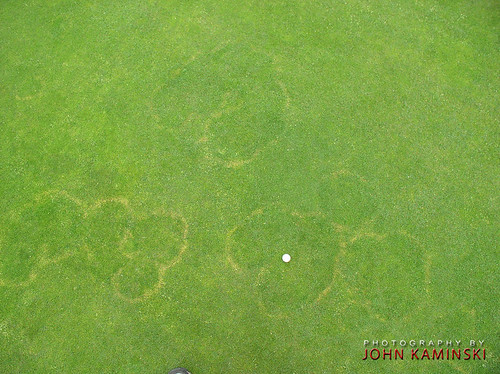
As mentioned previously, brown ring patch (Waitea circinata var circinata) is active in the West. Comments on our Facebook page also say that the disease is pretty active in other parts of the US. I got a little treat by email this week from a superintendent in southern California who sent in a picture of disease on his 2 year old bentgrass greens. Although the rings are not what we typically see with brown ring patch (BRP), this really looks like the pattern of the disease. Although bentgrass is normally more resistant to the disease, BRP has been diagnosed from creeping bentgrass in the West a few times this last year. Anyone else seeing this on creeping bentgrass this year? We're still confirming Waitea or not, but dang, that would be something new if BRP starts becoming more active on creeping bentgrass!

How Many Facebook Friends You Got?


Finally, just some concern and observations. As you know, our blog is linked to The Turf Diseases Facebook Page . You may have also noticed that there is a Facebook page for Poa annua and Creeping Bentgrass.

Current Friend Count:
Creeping Bentgrass: 254
Poa annua: 587
Turf Diseases: 649

So...just an observation, in the world of Facebook, Poa is more popular than Creeping Bentgrass. Turf Diseases is more popular than both of them. If we were in high school, that's be kind of like the nerds being more popular than the homcoming queen. How much longer do you think that Turf Diseases will have more friends than Poa annua? If it's anything like how the real world is, I have the feeling that Poa annua is going to spread much faster than Turf Diseases will!

OK, that's all for this week! Signing off from the Right Coast until then....


The trip from hell and current disease issues


For those of you following my twitter or facebook account, you probably already know that I had been stuck in Europe for the past two weeks. While I often heard comments like "there are worse places to be stuck" and "I wish I were stuck in Paris", the actuality of it is that the snowball effect of being stuck in Europe was not fun (although I will admit that Paris is now one of my favorite cities in the world). More on my travel problems below.

...as for the turf issues happening now.

While away, it was apparently back to some cooler weather around the region, but things are definitely starting to look more like spring around here each day. Annual bluegrass seedheads seem to be in full bloom and ratings taken last week confirmed that certain treatments can be effective at suppressing the seedheads when properly timed. I will mention that we did see quite a bit of damage as well from some treatments.

In addition to Poa seedheads, brown ring patch seems to be rearing its ugly head again this year. Remember to follow recommendations of found in previous posts to control the disease. Another chronic disease that is active in certain parts of the northeast is anthracnose basal rot. A sample was received today from a golf course that was showing active conidia (spores) of the anthracnose pathogen. I noticed reports of this disease a few weeks back, but believe that most have gotten it under control. This is definitely good news and cases of anthracnose starting this early definitely is not a good sign going into the season. When cases start extremely early (right after snow melt) we usually see things clear up and not persist throughout the year. When cases start showing up in May and June, then the disease seems to last all summer long and cause the most problems.

Early season dollar spot treatments should have been applied in most regions within the past 2 weeks as well. I have not kept up with what is happening in all regions, but at least from what I can see in State College, PA things have been considerably dry and we have even seen some drought damage starting to appear on putting greens. It seems a little early and many of you will push the limits early in the season in order to pre-condition the plants to the stress, but be careful not to go too far as damage has been observed this year.  Of course, rain over this weekend and early this week make the last few sentences a mute point.

As for my time in Europe...

Once the volcano in Iceland started sending ash everywhere all hell broke loose with regards to travel in Northern Europe. Flights were canceled across the board in what they called the worse air traffic problem; surpassing 9/11. In my attempt to get back to the states in reasonable time frame, I was shuttled from Paris to Amsterdam, back to Paris and then to Madrid. This involved about 10 hours in line at train stations, gouging in terms of pricing of hotels, and many hours on the trains. Finally, when we thought all was squared away we got stuck in Montpellier, France because the French train workers were on strike. We ended up renting a car and driving over 900 km through the night to arrive in Madrid at about 3AM on Tuesday night/Wednesday morning. We finally made it out of Europe and back to the US at about 11PM Thursday night. For all of you hearing about the situation on the news...I can first hand say that it was worse than you could imagine!  Lesson learned though...when travel troubles like this occur in the future, you can bet that I will just find a seat in a nice street cafe in Paris and relax.  Chasing the travel only made things more stressful and didn't really get me home any sooner!

At least I got to see some cool things while in Paris:

Microdochium patch kicking in


Walking around the Valentine Research Facility this morning brought some new disease activity to my attention.  Despite the unseasonably warm weather we had this past week, the slight change in temperatures and moisture finally kicked Microdochium patch into gear on our putting greens.  Although most of the damage that we had noticed prior was caused by gray snow mold, this was brand new activity.  Actually, when I first looked at the symptoms it reminded me of some type of hydraulic or fuel spill.  It was fairly scattered and not too severe at this point, but microscopic examination confirmed the condia (spores) of Microdochium nivale.  I assume that the wet, weather we are scheduled to get over the next two days (combined with more typical temperatures for the mid-Atlantic and Northeastern US) will bring some moderate cases of the disease.  There are probably a lot of fungicides that can control the disease, but it seems that most are utilizing tank-mixtures of chlorothalonil + iprodione as their drug of choice.


In addition to the Microdochium, we have seen select cases of cool temperature brown patch and brown ring patch.  As we have stated in previous posts, identification can be made by incubating a sample in a ziplock bag or tupperware container with a moist paper towel.  If mycelium is present in the morning, you are likely dealing with brown ring patch.  It seems a little early for BRP in most parts of the NE, but with the weather being so screwed up for the last week anything is possible.

Aside from the disease front, many of you may have read the facebook post about annual bluegrass weevils.  According to the USGA agronomists in the Northeast, adult annual bluegrass weevils are already on the move and have been captured in pitfall traps on a golf course in Fairfield, CT.  This is once again early for the little buggers and superintendents would be wise to keep a close eye on this if you have 1) high populations of annual bluegrass and 2) have had a history of ABW damage in the past.  For those of you not dealing with this insect, take it from many of the golf course superintendents in the Hartford region...they are a pain in the rear and resistance problems showing up in the last 4-5 years have made their management even more difficult.

Aside from the bugs and the fungi, now is also the time to start planning for your annual bluegrass seedhead control.  Depending on your choice of PGR (Embark or Primo/Proxy), you will be targeting the seedheads soon.  These control measures are often hit or miss and can vary significantly depending on the location on the course.  As you know, many superintendents base their application timing on cumulative degree days.  Although I still don't think these are great models, they can assist in determining approximate timings.  For everyone in the NE, you can check out Cornell's Forecast site for an update on cumulative degree days.

Cold and wet and that damn groundhog


Well, I guess we can "officially" [I just jinxed us] say that winter is over. That damn groundhog in Punxatawney, Pennsylvania screwed us again with the extended winter and my wife even suggested that she may be willing to have someone "take him out" next year. Regardless of whether you enjoyed this snow-filled winter or not, the bottom line is that spring is quickly approaching and it is now time to start planning your disease management programs.

Based on Frank's post last week, I would expect that brown ring patch is just around the corner for turfgrass managers in the Northeast (although some in the mid-Atlantic may be a little ahead and already seeing symptoms).  The biggest thing I have been seeing is cool temperature brown patch and gray snow mold.  With the cold, wet weather throughout much of the Northeast, golf course superintendents should make sure that they are identifying the type of snow mold on their property.  While much of what I have seen in the field looks a lot like pink snow mold, we have actually diagnosed it as gray snow mold.  More specifically, we have identified it as Typhula incarnata based on the orange sclerotia and presence of clamp connections on the hyphae.  While you can't see the clamp connections without a microscope, you can easily identify the sclerotia without the aid of a lens [or if you have poor eye sight, you may need a low powered loop].  If you are dealing with gray snow mold, there is not much that needs to be done in the form of fungicides.  The damage is done and you should now be in recovery mode.


(Above) Sclerotia of Typhula incarnata within creeping bentgrass.

On the other hand, if you do not see sclerotia within these infested areas it is likely that you are dealing with pink snow mold (Microdochium patch).  This may end up being a big problem in the coming weeks as the turf is likely saturated from all of the melting snow and the large storm that has battered the Northeast over the past few days.  In situations where you haven't quite fired up the sprayer or where the greens are just too wet to get on right now, the disease may continue to spread and cause significant damage.  If this is the case, you may consider pulling out the sprayhawk to treat greens with minimal disturbance.

In addition to your planning, the authors here at Turf Diseases have also been doing a little preparation to better serve you as we enter the disease season.  This past week, we launched the Turf Diseases Fanpage on Facebook.  I have to admit, I have been pretty much out of the FB loop and more consumed with the blogs and twitter, but in our first week on FB we had over 350 new fans.  I guess that the blog and twitter still aren't mainstream enough for you so I am glad we added the function.  I hope that everyone will take advantage of the interactivity of the site and contribute.  A brief shout out should be given to Chris Tritabaugh of Northland Country Club for posting the first fan photo (gray snow mold) and to Keith Angilly, Frank Tichenor, and Peter Rappoccio for giving me some insight into what is going on in Connecticut and New Jersey.  Peter and Keith even got into a little discussion about the efficacy of Civatas, which seems to be a popular topic on these threads and it is gaining a lot of attention with only limited information available.

Click below to become a fan of Turf Diseases on Facebook!

It's Waitea-licious!


Waitea, Waitea, every where,
Yellow rings all over my grass;
Waitea, Waitea, every where,
What a pain in the ass.
(apologies to Samuel Taylor Coleridge for bastardizing The Rhime of the Ancient Mariner)

OK - I get fooled more than I'd like to when it comes to recognizing turf diseases. A few weeks ago I received the photo of rings on creeping bentgrass (above) from Gabe Towers from Target Specialty Products in Arizona and said "that's take all patch!" despite Gabe thinking it was a Rhizoctonia disease. After isolations from the turf - we did confirm that the damage was caused by Waitea circinata var circinata aka "brown ring patch". Unlike the nice yellow rings that the pathogen causes on annual bluegrass, this is what Wcc looks like on bentgrass. Thus the name "brown ring patch" as described by Japanese plant pathologists who first characterized the disease on creeping bentgrass.

BRP is pretty active in California right now - showing up on both annual bluegrass and rough bluegrass putting greens.

One question that came up this week at a meeting in San Diego was "If I have active BRP going into spring aerification, should I worry about it?" I think that it shouldn't be a problem if you apply a good shot of nitrogen after core aerification - at least 1/2# N per 1,000 sq ft should help reduce down the severity of the disease. If it's still active a week or two after aerification, a shot of fungicide should help get rid of it, but the combination of N fertility and OM/thatch removal should help reduce the disease.

As far as fungicides, I heard some concerns over the short residual control that Endorse/Affirm was giving on greens. If you tank mix the polyoxin-D application with 1 fl oz of Banner MAXX, you should get 28 days or more control of the disease (outside of California, you could use 0.28 oz of Tourney or 1 fl oz of Trinity in place of the Banner MAXX in the tank mix if either Tourney or Trinity is available). A follow up application a week to 2 weeks later with 2.2 oz of ProStar will give you near cmplete control of the disease, but often with the increased N, the first Endorse or Affirm application with a DMI should do the trick.

Fairy Ring Activty
With spring coming in the West, we're also picking up some increased fairy ring activity. Green rings or mushroom on your turf are a sure sign of fairy ring activity . Although a number of fungicides can work vs fairy ring, it's also important to apply the fungicides in an adequate water volume or water it in - see Lane's fairy ring profile here, as well as Mike Fidanza's water volume and surfactant work here.

As mentioned in previous postings - using the magic plastic bag to see where the fairy ring is in the soil (near the surface or way down in the soil) can help you judge how far you need to push your fungcides into the soil profile with water to get good control.


In the photo above - you can see the white fairy ring mycelia in this sample (incubated overnight in a sealed plastic box) poking out from the soil (on the side of the plug) up to a few inches down from the surface. in this case - you'd know that you'd need to get the fungicide down to this level to get adequate control.

OK - that's it for this week. I'm back in DC after a week in sunny California, good thing the snow is finally melted here!

Signing off from the Right Coast....

Brown Ring Patch, Polyoxin-D & Savage Pathology Style Q&A


Sorry for barging in on Megan's Friday posting but better late than never :)

Brown Ring Patch on Creeping Bentgrass in Arizona?
Gabe Towers (Target Specialty Products) in Arizona sent these pictures in from a creeping bentgrass green at a course outside of Phoenix. According to his observations, it's definitely a Rhizoctonia-type disease and the mycelia and symptoms look an awful lot like what we would expect brown ring patch to look like on bentgrass. Unlike the bright yellow rings associated with the disease on annual and rough bluegrass, brown ring patch on bentgrass makes nice brown sunken rings. These symptoms are like those first described for the disease orginally in Japan on this turf type.


One of the things that we're seeing here is also the development of patches without rings. Although rings are typically seen with the disease, we did isolate Waitea circinata var. circinata from similar patches in Idaho last year.

The most compelling evidence for brown ring patch would be the presence of aeial mycelium after incubation plus the sunken degraded thatch on the greens.

We're working with Gabe right now to confirm the pathogen identity, but if it is brown ring patch, that'd be a first for the disease on creeping bentgrass in Arizona.

Polyoxin-D: Soon Available in Two Fruity Flavors!
Well, not really. Polyoxin-D fungicides kind of smells like Top Ramen to me. Polyoxin-D has proven to be one of the best fungicides for brown ring patch control and will soon be available from two companies in 2010. There's a little bit of a backstory on this one, but I'll skip the details and just say that two formulations from two different companies will be available soon.

Endorse 2.5WP is now part of Arysta's line of turf fungicides. It was previously marketed and distributed by Cleary Chemical, and we should expect no major changes to the label and the use rate will continue to be at 4 oz per 1,000 sq ft.

Cleary Chemical will now be selling Affirm 11.3WDG. This has about 4x more polyoxin-D than Endorse, so the expected use rate will be 1 oz per 1,000 sq ft.

For more information (as it becomes available) please see the maunfacturer websites:
http://www.arystalifescience.com
http://www.clearychemical.com

Question of the Week
This is kind of a new feature for the Left Coast blog, but inspired by columns such as Dear Abby, Car Talk, and Savage Love, and the slow down of info this winter, I'm going to try to post Q&As recieved by email.

Hi Frank,

I am looking for a third product for snow mold control on poa greens (monterey peninsula). My curent rotation is Instrata followed by Chipco GT every 14 to 21 days depending on the disease pressure. I was considering Eagle in combo with Fore any thoughts?

Thanks in advance,
Moldy in Monterey


Dear Moldy -

Pink snow mold in California can be tricky since it can fire at cold (< 65F daytime temps) and wet conditions without snowfall. As you know, it can go from 50 to 80F in a week in parts of California during the winter, especially in southern California, making this disease somewaht unpredictable. As such, creating a clear, defined pink snow mold (aka Microdochium patch) preventive fungicide program can be dififcult and often superintendents end up making a lot of curative applications for this disease. Please look at page 16 from Paul Vincelli's (University of Kentucky) overview of turf fungicides - the ratings are based on the average of trials performed for the last 10 or so years over all of the US.

www.ca.uky.edu/agc/pubs/ppa/ppa1/ppa1.pdf

Can you use PCNB? If you consistently stay below 70F during the winter - PCNB is really useful - long lasting, no resistance, cheap - but, if it goes over 70F, you can potentially get burn and or root pruning at high rates. Maybe target PCNB apps for the coldest part of the year , saving your Instrata applications for times when temps can get warmer.

Since Instrata = Banner + Medallion + Daconil, Medallion and Daconil are probably limited as alternate rotation partners due to label rate limitations.

You can use another DMI (Banner, Eagle, etc..) in the rotation since DMI resistance really hasn't been an issue for pink snow mold yet - but as you can see from Paul's chart, some DMIs work better than others. It'd probably be a good idea to mix this application with something else for added protection. As you indicated, mancozeb (Fore) is a good choice in your case.

I think the QoIs (Heritage, Compass, Insignia, Disarm) can be dicey for snow mold control; we've seen a few cases of resistance in CA, but this topic needs a lot more research. Thiophanate-methyl should be used with caution, resistance has been around in WA since the 1980s.

Finally, good call on the Chipco 26GT as a rotation partner. Since tolerance may be an issue in some places, keep the rates on the higher end or mixing with a contact such as mancozeb in your rotation may help.

How's that sound?

Thanks,
Frank

That's it for this week. Signing off from the Left Coast.....

Widespread Death & Destruction in Portland? No. Beer and Doughnuts? Por supuesto.


As you already know, many of the plant pathologists in the U.S. were in Portland this last week at the American Phytopathology Society meetings. As mentioned last week - Phil Harmon (Florida), Bruce Martin (Clemson) and Shanna Mazurek (North Dakota State) joined me on a quick tour of Portland Golf Club and Waverly Country Club on Saturday morning before the meeting. With temps in the 100s earlier in the week and a lot of wall to wall annual bluegrass - I was expecting to see nothing but brown up here. Arriving at PDX - I could see lots of dead grass from the air. However, on Saturday morning, I was very (pleasantly) surprised to see awesomely good course conditions at both Portland GC and Waverly CC. Thanks again to Forrest Goodling and John Alexander for the day and Gordon Kiyokawa for setting us up.


Forrest Goodling (Portland GC) - it was so hot recently that the thermometer couldn't even keep up with the 100+ degree weather.


The view of the club house at Portland GC - watching the weather and timely irrigation kept the Poa green during the hot hot heat.


Bruce, Shanna and Phil on the Willamette River - you can see what happened to a lot of grass in the PNW during the heat wave if it wasn't cared for.


John Alexander (Waverley CC) "schooling" Bruce on annual bluegrass and billbug damage.


John Alexander showing off some of the wickedly sloped (and fast) greens at Waverley.

Overall it was a great time seeing the courses and having Forrest and John share with us their experiences and expertise on turfgrass in Portland.

APS Annual Meeting (www.apsnet.org)
As far as the meeting - I have to admit, I did not spend all of my time discussing turf while there. I was mainly wearing one of my other "hats" and focusing on new fungicides and fungicide resistance development in agricultural crops. I am hoping that Megan can give us a summary of some of the cool turf stuff (other than what Jim already mentioned yesterday about the work being done by Steve Kammerer and Phi Harmon) from the meeting.

Two things to note (1) just to make things even more complicated, the name 'Chrysorhiza' is going to be more frequently associated with 'Waitea' and 'brown ring patch' - but for good reason (2) I'm "officialy" going to be working more and more with the EPA in Washington DC on fungicide resistance issues starting in January as part of a fellowship and sabbatical in 2010. More to follow on both in the weeks to come.

Beer and Doughnuts
Portland definitely lived up to its reputation for beer and doughnuts on this trip. With over 100 microbreweries - I tried my best to sample as much of the local brew as possible. One night was even punctuated with a late night run to Voodoo Donuts - I wish I had some better pictures - but unfortunately - all my iphone camera could capture in the dark were images like the one below - but the picture does the situation justice. After a very very very long day of plant pathology talks and a few microbrews - my own world pretty much looked like what was captured by this camera.


Paul Koch (Univ. Wisconsin), Lane, and Damon Smith (Oklahoma State) out on a late night donut run. Missing: Brandon Horvath (Tennesee) holding a big pink box (of doughnuts).

I'm very lucky to be working with such a great group of turf pathologists from around the country, they really do play hard and work harder. Most importantly - it was a great meeting and opportunity to discuss turf disease issues from across the country.

Meanwhile, Back in Cali....
Naveen has definitely been using the bat-phone this week. She reports that the diagnostic lab is getting slammed in Riverside. Anthracnose and heat stress are very common on cool season turf. Root infecting diseases like Kikuyugrass/Bermudagrass decline and soil diseases like fairy ring are also showing up because of the effects of summer stress. I think the blast of heat we had in a few locations is catcing up with us.

Weather wise - it's definitey cooled down this week (no Pythium alert outside of Coachella), but still expect to see the typical summer diseases inland and dollar spot/brown ring patch on the very moderate coastal locations (70s-80s).

Signing off from Top-Pot Doughnuts in Seattle (that's another story),

- Frank

Coolest July on Record!


Well the big news from the Midwest is we just experienced the coolest July on record! I guess you can imagine that there is not a lot of disease activity. Dollar spot is progressing, but very slowly. Even at one particular site in Milwaukee that is usually a petri plate for dollar spot, the disease has been very slow to develop.

We have had some brown ring patch come through the lab recently and most people in the Midwest are able to clean that disease up with an application of Endorse or Prostar. Dr. Frank Wong has also shown that applications of nitrogen fertilizers also help to alleviate brown ring patch symptoms.

This post will be a little short because I have just returned from Portland where I attended the American Phytopathological Society meetings. Another fantastic meeting! I will let Frank elaborate on the fun sites :)! There were some excellent talks and posters. One talk I thoroughly enjoyed was by Steve Kammerer who is at the University of Florida. I know we do not grow warm-season grasses, but nonetheless Steve and Dr. Phil Harmon may be instramental in renaming or changing Rhizoctonia classification. Great job guys. For those growing warm-season grasses and are struggling with something a little weird, you might want to get in touch with Dr. Harmon or Steve.

One final note, this weekend is projected to be quite warm in the Midwest, so if you have not sprayed for dollar spot in a while tomorrow or Friday may be a good time.

If it's green, what's that mean?


Remember that schoolyard rhyme, "If it's yellow, let it mellow, if it's brown, flush it down"? Well, if it's green, what's that mean? Sometimes in the aftermath of a brown ring (Waitea) patch outbreak on Poa greens, even if you've controlled it with fungicide applications, you can get some strange green patches that form. (Image to the left courtesy of PJ Kaner at Santa Teresa Golf Club in San Jose).

We're attributing this to the pathogen breaking down thatch as it develops on greens, giving a fairy ring like effect in he areas that it's grown through. Often these areas will be softer and spongier than the rest of the green.

Often, when we examine these areas - we'll find lots of Trichoderma (a fungus known for parasitizing other fungi and the active ingredient in some biocontrol products), black sclerotia (next image to the left, courtesty of Larry Stowell - PACE Turf Research Insititute - www.paceturf.org) and other junk fungi colonizing the previously affected area. This can confuse diagnosticians if you send in samples from these areas - and often no 'real' pathogens can be found in these areas.

The key for avoiding this "by product" of brown ring patch infections is to treat early with fungicides when you see symptoms to prevent extensive thatch colonization on greens. You can also bump up your N fertility or even apply some chelated iron in combination with N to mask these symptoms.

Whew! We made it through the 4th of July!
Lane mentioned to me earlier this week in an email that life is good if you make it through the 4th of July without losing any fingers. I can say the same about avoiding disasterous anthracnose outbreaks over the 4th of July on Poa greens out in the West.

Fortunately - no 911 samples came in on Monday morning with anthracnose. There were a number of fairy ring samples, take-all on bentgrass and Bipolaris leaf spot that did show up. These are diseases that typically will cause more damage on heat and drought stressed turf - so it did get hot here in California, but it looks like most of our guys avoided big anthracnose outbreaks on Poa greens.

Also - no gray leaf spot yet!

Hot Inland, Mild on the Coast
The California weather outlook will be basically 70-80s on the coast and 90-100s in Inland Valley s and if you're out in Palm Springs 100-110s.

Expect to see a continuation of dollar spot, Waitea patch and rapid blight in coastal areas. Anthracnose and summer patch will be threats in Inland and Central Valleys. If you're in the desert - bermudagrass should be booming with cool season grass all but disappearing in the summer heat.

Le Tour de France - It's Not Golf, but....
The big race started in Monaco this last Saturday and continues on for another 3500 km for the next three weeks. Lance Armstrong is back after a 4 yr hiatus - maybe to claim an 8th overall victory. There's probably more Americans in the race this year than ever and Team Columbia-HTC, based out of San Luis Obispo, CA is dominating the early flat stages in the race. Lance's team (Astana) took 1st place in the team time trial on Tuesday and Lance sits a mere 0.22 seconds behind the current race leader Fabian Cancellara (Team Saxo-Bank). Friday brings the first of the mountain stages and we'll see how the overall leadership of the race changes as these guys put on their best mountain goat impersonations through the Pyrénées mountains.

Signing off from the left coast until next week.....
Related Posts with Thumbnails