Custom Search
Showing posts with label Microdochium patch. Show all posts

Things are picking up FAST!


Yesterday (this was meant for yesterday, but new disease activity today [Tuesday] has me posting a day late) I had the pleasure of hanging out at the Rutger's Annual Golf Classic which raises funds for their research program. I even got to play a little golf with our Midwest blogger Jim Kerns. Having left State College on Sunday and not really seeing much of anything on the disease front at Penn State, I was excited to find out if there were any actual turf diseases in the field...we hit the jackpot in North Jersey.

While certain diseases like anthracnose, leaf spot and brown ring patch were very active, I was surprised to see active dollar spot and RECOVERING brown patch (looked like it was active about a week ago or so). I think that things have been some moist and humid that everything is just taking off at this point. This would definitely be the earliest I have ever seen brown patch in the mid-Atlantic region and is in general pretty early for dollar spot as well.

Thatch collapse
This morning I headed into the Valentine research facility in State College and was surprised to see a LOT of disease activity there as well. We still don't have any dollar spot and brown patch is definitely a ways off for us, but there are several things going on. First, seedheads are in full force right now and we will be rating our plots over the next few weeks to see what worked and at what timing. As for diseases we are seeing: red thread, leaf spot, brown ring patch (images below, we are confirming by isolation...update to come), thatch collapse (see next month's GCM issue), Microdochium patch, and probably something else that I am forgetting.


So diseases are here or just around the corner...we could be in for another long year.

Thawing out


Well, I'm finally running at about 80% speed after being knocked on my butt from a double-whammy of a cold AND food poisoning. My sweetie, Kris, had to deal with a very yucky Valentine this week. I'm hoping to be 90-100% back-to-normal tomorrow. On Tuesday, as the cold really came on strong, you could have graphed snot-production on an exponential curve...


Me and my Valentine of 10-years, on a less-snotty day!


The high yesterday and Wednesday was about 70, and virtually all the snow is gone except for giant piles in parking lots, and those are fading fast. I have not heard from anyone regarding pink snow mold/Microdochium patch but I suspect there may be some out there. The forecast for the next week is pretty crazy (see below). Microdochium patch doesn't need snow, just cool/wet temps, so keep your eyes out.


Another disease that frequently appears in this region around this time is yellow patch/cool-season brown patch. This disease usually goes away readily on its own as the temp warms up and grass gets growing. That all depends on weather. I have seen yellow patch symptoms into mid-April.


The above photo of yellow patch was from Feb 2008.


Freeze/Thaw and Drainage

The forecast calls for a few more days of warm temps, then showers, snow, and cold (lows in the teens). This type of weather can lead to a lot of cycles of freezing/thawing which can cause damage to turf.


There are a lot of reasons to address drainage problems. Freeze/thaw problems is one more to add to the list!

Labels


If you recall, 2-3 weeks ago I talked about a new web-distributed labeling system that the EPA was testing out. I pasted some info from a fruit newsletter that I receive. The comment talked about some correspondence among EPA, Greenbook, and CropLife America regarding the web distributed labeling. The correspondence was posted here:

http://www.epa.gov/pesticides/ppdc/2010/dec2010/session3-willsltr.pdf

To Spray or Not to Spray


It is really nice to experience a warm-up in Mid-February, but we know that it is a likely a cruel trick from mother nature. NBC 15 in Madison just said that Monday could yield 5 to 10 inches of snow, if all the expected precipitation is snow. Yet, today temperatures exceeded 40 degrees in Southern Wisconsin and is expected to exceed 50 degrees tomorrow! Its funny that I get excited about 50 degrees, when I was in North Carolina I considered that cold. As the warm-up continues, the snow will be melting and gray snow mold and Microdochium patch may show their ugly heads. If fungicides were applied last fall, then I would not expect too much damage. However some areas south of I-80 may not have made preventative applications. I know many down in Missouri, Arkansas, and maybe even Kansas did not make preventative applications. Based on the duration of snow cover in those areas, gray snow mold will most likely not be a problem. Microdochium patch however may be a problem.

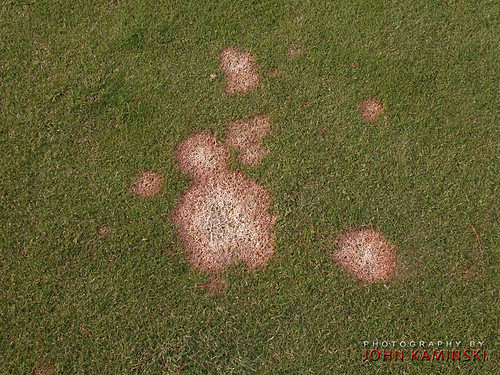
The question arises, should I spray when the snow melts? To determine if an application is warranted there are two things to consider: 1) Is the fungus causing new infections? 2) Is the ground saturated? When the snow melts Microdochium patch symptoms maybe apparent and severe, but if environmental conditions are not conducive the pathogen will not continue to spread. Microdochium patch will continue to develop when temperatures remain below 68F with high humidity, intense cloud cover, or both. Symptoms immediately after snow melt usually have the "classic look" with a pink or orange tint. An image of these symptoms are at the upper right hand side of this post. If environmental conditions are conducive for Microdochium patch development in the absence of snow, symptoms will have a water-soaked appearance with center gradually turning a light brown. An image of those symptoms are below. If there are any questions about the activity of the fungus send a sample to a diagnostic lab.


Another factor to consider is how saturated the soil is. Applications of any material to saturated ground should be avoided entirely. Failing to do so could result in loss of the material to runoff. Another consideration is running equipment over saturated ground will likely do more damage than the fungus will.

If conditions become conducive for Microdochium patch development, there are fungicides that will halt its development. Fungicides with the active ingredients iprodione, vincozolin, thiophanate methyl, trifloxystrobin, azoxystrobin, pyraclostrobin, fludioxonil, and chlorothalonil are effective against Microdochium patch. Normally it is hard to beat the dicarboximides and thiophanate methyl for Microdochium patch control, but there are other options that maybe more relevant in your area. Chlorothalonil does not perform all that well by itself, but it is a good tank mix partner with any of these other products.

On another note, after receiving much ridicule from Dr. Kennelly and the Packer Nation that surrounds me about the tragic loss the Bears were handed by the Packers, I am looking forward to baseball Spring training. Like I say every year, as all Cubs fans do, this is the year to break the Billy Goat curse!

Instrata (Chlorothalonil + Propiconazole + Fludioxonil)


Instrata is another fungicide that combines different active ingredients into a single product. Instrata has chlorothalonil (Daconil and many others), propiconazole (Banner MAXX and others) and fludioxonil (Medallion). Instrata quickly became the gold standard for snow mold control in northern climates like the Upper Midwest. Interestedly the formulation of this product combined suspended particles with a microemulsion that Syngenta calls a suspomicroemulsion. I really don't know what that means for golf course superintendents, but you have to admit it sounds cool! All kidding aside, we typically suggest that active ingredients should be mixed in order to achieve acceptable snow mold control. With Instrata you have three active ingredients that when combined do provided excellent snow mold control. Chlorothalonil is a contact fungicide that has activity on all three snow mold pathogens (Microdochium nivale, Typhula incarnata and Typhula ishikariensis), but is strongest on M. nivale and T. incarnata. Propiconazole is a DMI fungicide, which are known to have excellent activity on T. ishikariensis and fludioxonil seems to have activity on all three snow mold pathogens too.

For those who manage golf courses in areas that receive intense snow cover will likely experience all three snow mold pathogens at one time or another. I think the reason Instrata is a successful fungicide for snow mold control is golf course superintendents don't have to worry about predicting the weather because all the product works on all three snow mold pathogens. With respect to efficacy of Instrata, I have posted a few figures highlighting how well this product works. We do see breakthrough at our site in the UP, which has intense snow mold pressure. Yet, for the last two years we observed that 70 % of the products break down under that pressure. Even under that pressure, a single application of Instrata keeps disease severity levels between 15 and 40 %. Anyone that experiences such snow mold pressure should make two applications for snow mold and we observed that two applications of Instrata at 5.5 oz worked better than a single late application of Instrata at 11 oz at our UP site. For most golf course superintendents however, the 9.3 oz rate will work beautifully! A word of caution about the product, do not skimp on the rate in areas of high snow mold pressure. We have observed that reducing the rate to 5.5 oz in some environments may result in significant failure.


In summary, Instrata is an excellent combination fungicide for controlling snow mold diseases. It also has activity on other diseases too, which is obvious based on the active ingredients in the product. Instrata is an excellent choice for putting greens and tees and if the budget allows high value approaches and maybe even fairways. If you are interested in this product and have not used it before check out the label and Syngenta's website for more information.

Things to Consider Post PCNB Stop Sale Order


Hello again, its been a few weeks since I have posted anything. Except for the news about PCNB, the fall has been exceptional in the Midwest. Temperatures have been very conducive for golf, almost too conducive. I wonder if those who lost turf this summer had any difficulty recovering because of too much traffic during the fall season. Samples completely halted at the Turfgrass Diagnostic Lab around October 1st, mainly because we were fairly dry. The only disease that proliferated during the fall was rust, even some golf course superintendents called about massive amounts of rust in the roughs.

For those that had to select an alternative to PCNB there are a few things to consider for next year. First, one of the beauties of PCNB was its long residual control of Microdochium patch. Thus if Microdochium patch is observed after melt, than a follow-up fungicide application maybe warranted. Our research has shown that the fungicides iprodione and chlorothalonil only provide about 30 to 40 days of Microdochium patch control under winter conditions. Interesting enough we did not see extended control when comparing plots covered in snow versus those plots that were kept uncovered. The image above shows the length of control we observed with chlorothalonil. In other words, do not blame your snow mold fungicide mixture if new Microdochium patch infection centers develop during the spring immediately following melt.

The other thing to keep in mind is the issue with PCNB has not been resolved, at least not to my knowledge. Basically it would be wise to think about budgeting for snow mold without using PCNB as an option. That way you are prepared if the stop sale is not lifted. There are a number of options that I have already covered in previous posts, but feel free to contact us if you want to discuss other options for next year.

Most of the bloggers attended in the Agronomy meetings in Long Beach, California last week. I love these meetings because of the breadth of information presented. One of my favorite talks from the meetings, besides my own students', was given by one of Dr. Frank Rossi's students David Moody. He has determined that potassium applications in the fall may make turf more susceptible to snow mold damage. They established a very elaborate growth chamber experiment to test this hypothesis, but they stumbled upon this observed causally in the field. Basically they think the excess potassium stimulates the plant to shuttle potassium, citrate and malate into the vacuole in order to maintain osmotic potential. In turn this shift in osmotic potential slows down the production of carbon skeletons and energy, which are essential to plant defense. I believe this was the first or second year of David's research and I will be interested to follow his results and progress.

One of the highlights of the meeting was an outside meeting to discuss a proposal for a Multi-State Regional Project on Dollar spot research. This is a formal process that will allow all those who participate to meet once a year to discuss dollar spot research. Originally this idea was spearheaded by Dr. Mike Boehm at Ohio State University, but the reins was passed to Lane upon Dr. Boehm's promotion into upper administration at Ohio State. The beauty of this meeting was hearing what everyone was doing and realizing that very few turf programs overlap with respect to dollar spot research. This project has a five year term, so maybe in five years we will have a better handle on the biology of dollar spot!

Stay tuned next week as we start a series of discussions on the newer fungicides released in the past couple years!

Cool Temperatures Bring a Sigh of Relief!


Temperatures in the Midwest are finally cooling down. This week has been a godsend as I heard from a superintendent this afternoon. Yes temperatures are going to rise again this weekend, but the nighttime temperatures are supposed to remain below 70 degrees. I agree with John that this is the time to start overseeding, fertilizing and maybe even aerifying to bring the greens back to life before winter. However, I do not think this is the time to start bringing the mowing heights back down and starting on paclobutrazol programs. I tend to be very conservative and I think this week is an ideal time to allow the plant to grow under the least stress possible.

This week’s cooler, dry weather has shut down most of the diseases we have dealt with this summer. I don't know this for certain for every location in the Midwest, but I do know that my phone was very quiet the last few days. We still are getting samples of Poa annua crapping out either from heat stress or summer patch or a combination of both. This was an exceptionally difficult summer for golf course superintendents. Most the turf loss this year was due to heavy rains in June and July coupled with high day and nighttime temperatures. Soil temperatures in many locations I visited exceeded 95F, which is not a good growing environment for any cool-season grass to say the least.

The major lesson I learned this summer was the importance of establishing a written set of maintenance and playability standards. By putting categories like day-to-day green speed, firm, fast or green, lush gives the golf course superintendent a lot of flexibility. For example, a hypothetical course has established a maintenance standard of 9 foot green speeds every day. By simply stating this standard allows the golf course superintendent to vary practices to achieve this ball speed. Viable options would be alternating mowing and rolling, switching to smooth rollers, and raising the mowing height in an attempt to minimize turf loss. I do understand that setting maintenance standards may not work for each situation, but it may be something to try especially at a public play facility. You may think I am crazy for talking about this, but based on my observations this summer establishing a set of maintenance standards seemed to work.

This is also the time to start thinking about snow mold applications. Here is a link for our snow mold trials for 2009-2010. The key with these reports is to look at the treatments that provided the best control (lowest disease severity) at the site closest to your site. We test a wide variety of chemicals and combinations at five locations in order to provide golf course superintendents with a plethora of options. We do not distill the reports down to the top ten best products because the best products and combinations may not be within the budget of many golf courses. So we always recommend finding the product or products that provide the best control and fit within the constraints of your budget.


Timing of snow mold fungicides was a fairly hot issue early this spring, largely due to some perceived failures of very good snow mold fungicides. We still do not have a great answer, so are initiating a fairly large fungicide timing experiment this fall. We expect to see good control from systemic products when they are applied well before snow cover, and good control from contacts closer to snow cover. We will let you know next spring, so stay tuned.

Snow Mold Rating Season Has Begun!!


Whoopee! Snow mold rating season is in high gear for us. The first site we visited last week did not have a lot of activity, but our site in Stevens Point, WI was fantastic! The non-treated controls averaged 90% disease and a few products had some break through. For the most part however, most treatments did a good job preventing snow mold. We have not had a chance to enter the data and analyze it, but mixtures did exceptionally well. Products like Instrata at 9.3 oz, mixtures of Trinity/Insignia/Iprodione, Interface/PCNB, Chlorothalonil/Myclobutanil/Iprodione were just a few examples that performed exceptionally well. Interface is a new product from Bayer that will hit the marketplace some time this summer. Typically most products do well at our site in Stevens Point WI, but some of the excellent products and mixtures break down under the intense snow mold pressure at our site in Marquette, MI. We really do not know what to expect at our sites in Minnesota this year. I think both sites had substantial snow fall and cover, but one site is new and snow mold development at the other site is variable.


We do exhaustive testing of products for snow mold control and the main lesson is to combine fungicide families to achieve excellent results. Using just a single product with a single active ingredient is asking for break through. At least that is the case in the Upper Midwest. We do not have a single answer for what to apply for snow mold control because it depends on the pathogen normally observed, the courses budget and the threshold for damage. Since we do not have crystal balls to forecast the amount of snow during the winter months, combining active ingredients will ensure protection against Microdochium nivale and the two Typhula species. Combining a.i.'s usually works very well in our trials, especially those combos that are strong on ascomycetes and basidiomycetes. Pre-mixed products like Instrata and Interface usually accomplish this strategy. Chlorothalonil, propiconazole and fludioxonil are the a.i.'s in Instrata and Interface is a mixture of iprodione and trifloxystrobin, both mixtures have good activity on snow mold fungi. Pre-mixed products are not necessarily the best and golf course superintendents can develop their own mixtures. We have last year's snow mold data posted on the Turfgrass Diagnostic Lab's website, but if you are interested please check back in a couple weeks to see this year's data! For those in the Upper Midwest, we will be conducting Snow Mold Field days on April 14th (Minnesota??), 15th (Stevens Point, WI) and 16th (Marquette, MI). Please contact me (jkerns@wisc.edu) if you would like to attend. We do not charge for the events and we will have the specifics after next week. Stay tuned for photos from our more northern sites next week.

Interesting Winter Disease in the Midwest


Happy belated New Year to everyone! I wanted to thank John for the wonderful birthday post! What a great photo and yes it has been cold enough here to warrant hair on every millimeter of skin! Although the winter in the Midwest has not been as abnormally cold when compared to other parts of the country, we have had some extended periods of extreme cold and snow cover since December 9th. South of I-80 there is not as much snow on ground as areas north of I-80. So there is not a lot to talk about in the Upper Midwest, except that ice damage could likely be an issue this year. Why? We haven't completely lost snow cover, but we have had some melting that has probably lead to ice formation underneath the snow. So you may want to keep an eye on areas that are prone to ice damage.

Besides letting everyone know that I am still alive, I wanted to post something that I thought was pretty unusual. Dr. Derek Settle with CDGA sent me the image attached to this post. The symptoms were necrosis of the leaf tissue atypical of gray snow mold or Microdochium patch plant and stand symptoms. Dr. Settle examined the affected leaf tissue and surprisingly found a bunch of oospores in the mesophyll cells (sexual spores of Pythium species). Dr. Settle then successfully isolated Pythium out of the affected tissue and sent the isolates to me for identification. I just got the isolates last week and I have not identified them yet, but I do know that it is a Pythium species.

I would be lying if I said I wasn't skeptical of Dr. Settle's diagnosis. I was not a believer in cool-season Pythium diseases in turfgrass, but it appears I have seen light!

I wanted to post an update on some of research that Paul Koch is conducting, but we have not analyzed the new data yet. I will post the most up to date results on fungicide degradation during winter months next week or the following week.

No Fun


I hope everyone out there had a great Thanksgiving last week!

Here in California, it's been pretty slow in the Wong Lab. Things are getting pretty cool here (by California standards) and here in the picture, you can see our Tifway-II is pretty much headed into full dormancy in Riverside with our soil temps in the mid-50s. My PhD. student, Chi-Min Chen, and undergrad lab assistant (Erica Serna) are helping me inoculate plots with Ophiosphaerella korrae - one of the causal agents of spring dead spot. I heard the comment of 'this is no fun' a few times this morning which reminded me of a joke my mom told me when I was a kid. It kinda goes something like this:


Q: "What was the name of the first Chinese test-tube baby?"
A: "No-fun Son"
(apologies to the defenders of political correctness out there)

For those who didn't get that maybe this will help:
http://en.wikipedia.org/wiki/Artificial_insemination

The 'maladie de la semaine' continues to be rapid blight on annual bluegrass greens - temperatures in the 60s-80s and a lack of substantial rainfall is allowing salts to continue to accumulate and cause conditions that favor rapid blight.The half-inch of rain that we got in parts of California last week didn't help much in knocking salts & sodium down, e.g. we need substantial or consistent rain to help us flush out the last several months of sodium accumulation on greens.

However, we're expecting some rain and showers, especially in northern and central California starting this weekend /early next week and lasting for a few days. That's great news as far as knocking down salts but bad news as far as Microdochium patch/pink snow mold.With a few days of moisture and daytime temps < 65F, we'll likely see some pinkie firing on annual bluegrass. If you don't already have a preventive fungicide application down, it'd be a good idea to squeeze one out before the showers and rain start in the next few days.

Signing Off from the Left Coast Until Next Week....

The Disease Triangle (part 2): The Host


Everyone that has sat through a pathology or disease lecture has heard of the disease triangle. Consisting of the environment, the pathogen, and a susceptible host, the disease triangle is a critical component of understanding disease pressures on a golf course. In a previous post I talked briefly about the importance of the environmental (weather) component of the triangle. I thought that as we wrapped up the season in the Northeast, I would take this time to speak about the importance of the host.

Unlike cropping systems where the purpose of the host is to grow a plant as large as possible and harvest it for sale or distribution, turfgrass managers must deal with a perennial crop that hopefully remains healthy forever (or at least for a long period of time). So instead of just trying to get to harvest, we must figure out a way to manage the "crop" during the good times and the not-so-good times. In the Northeast, just about all of the typical cool-season turfgrass species are grown and in the transition zone of the region we even grow a few warm-season turfgrasses. Growing grass in this region can be very difficult. Taking the extremes in weather out of the equation, there are still some important things about the host to take into account when identifying and managing turfgrass diseases.

When I first take a look at a turfgrass sample, identification of the genus and species is the first step of the process. Remember to look for key attributes including the vernation, ligule size, leaf tip, growth habit and other key components, Simply identifying the species can eliminate numerous pathogens as potential causes of the problem in question. For example, take-all patch is primarily a disease of creeping bentgrass. If the species affected is primarily annual bluegrass, then this disease can be ruled out (not to mention that take-all is primarily a disease of young putting greens of which little ABG would be present). To the contrary, a patch disease appearing primarily on annual bluegrass could limit the possibilities to summer patch or necrotic ring spot (or possible nematodes). Although summer patch may be present on bentgrass in the extreme heat of the Southeast, it is rarely (never to my knowledge) been identified on bentgrass in the Northeastern United States.

So being able to identify the species at your course can save you a lot of time and increase your chances of making an accurate diagnosis. There are too many diseases to talk about in this post, but below are some common hosts of typical diseases found in the Northeast.

Anthracnose basal rot: primarily annual bluegrass, occasionally creeping bentgrass (does not occur on both species on the same green)

Brown patch: most species, but tall fescue, perennial ryegrass, and bentgrass (particularly colonial bentgrass) are most susceptible

Dollar spot: all species susceptible, particularly important on bentgrasses

Summer patch: Kentucky bluegrass and annual bluegrass, also fine leaf fescues

Take-all patch: creeping bentgrass

Sometime prior to the end of the year, I will wrap up the discussion of the disease triangle with every pathologists most favorite component...the pathogen!

For a disease update, things are just about shut down, but dollar spot did pop up in recent weeks and microdochium patch continues to be active at select regions in the Northeast.

Microdochium patch running amuck!


Thanks to the lovely weather we've been experiencing in the Midwest, Microdochium patch has probably worn out its welcome. We just went through the second coldest October on record and I think one of the wettest! Absolutely perfect weather for Microdochium. Microdochium is a pathogen of many turfgrass species and can be especially severe on cool-season turfgrasses. The symptoms appear as small (<6 to 12 inches) water-soaked patches in absence of snow cover. Affected plants are blighted and may have a greasy appearance or may be a tan color. Stand symptoms can also have a pink or salmon hue evident after snow melt. Also symptoms tend to more severe after extended snow cover.


The conditions that favor disease development are cooler temperatures ( 32 to 60 F), high humidity and high nitrogen content in the leaf tissue. Snow cover is not required for this disease to develop, but is usually more severe when snow cover occurs. Microdochium management is fairly simple because many chemicals are efficacious. The tried and true combination for many people is a tank mixture of chlorothalonil and iprodione. Avoiding late season fertility applications seem to limit Microdochium symptoms. The exact timings to avoid are not know, but we are examining that particular question this winter.

Just returned from Pittsburgh attending the Turf Nerd Conference as John put it. The Agronomy Meetings are my favorite time of year. The graduate students at the meeting give fantastic papers and it is a real joy to find out what all of us are doing. For those that are not familiar with these meetings, our division C-5 is the second largest division in the Crop Science Society. Yet the camaraderie amongst the members of the division is great! I've heard that Pittsburgh was not a nice location years ago, but I really enjoyed my stay in Pittsburgh. Unfortunately I did not make it to Primanti Brothers. I did not have a bottle of Pepto with me and just getting over my recent battle with the flu I did not want to chance an upset stomach. Next time the corned beef and cheese sandwich is mine!!

The Most Wonderful Time of Year


We are in the midst of snow mold season in the Midwest, or at least Paul and I are traveling all over Wisconsin, Minnesota and the Upper Peninsula of Michigan. This year we have two sites in Minnesota- Edina Country Club in Minneapolis and a golf course in Baxter. The site in Baxter Minnesota is 100 miles from Fargo North Dakota and we have ventured up there to get a better handle on snow scald control. We received a lot of samples from that part of the country and superintendents have had difficulty controlling that disease.

We have two sites in Wisconsin-Sentryworld Golf Course in Stevens Point and Milwaukee Country Club in Milwaukee. Sentryworld is our old faithful site as it usually yields good snow mold pressure every year. However, we found out last year that treatments that work in Stevens Point may not necessarily work under extreme pressure. So we decided to venture to the UP of Michigan. Last year the snow mold pressure was intense in Champion Michigan and I suspect it will be again this year. We travel to all these sites to provide golf course superintendents the best possible recommendations for snow mold in there area. So check back with us next year when we finalize our trials, should be interesting.

On another note, I agree with Frank- the flu sucks! I have come down with the flu and I think it is the first time I have had the disease. Wow does this disease take the wind out your sails. I know I promised posts on all the different snow molds and I will do so starting next week. Sorry for the short post this week.

Old Man Winter Decends on Midwest


Not much going on in the Midwest last week or this week. Temperatures are 20 to 30 F below normal and we actually had appreciable snow this past weekend!! I have to apologize for not posting last week, I was traveling to North Carolina and did not have a chance to write my post. This week will be a short post too. Not much going on with respect to diseases in the Midwest, too dang cold!

The only good day the last couple of weeks was last Monday. We had the Wisconsin Turfgrass Association Golf Outing at North Shore Country Club in Mequon, WI. The weather was fantastic and considering the economy we had a nice turnout. I believe we had 84 participants, which included myself. The proceeds from the outing go to support the Wisconsin Distinguished Graduate Research Fellowships. We have four fellowships at the University of Wisconsin-Madison- Robert Newman (Horticulture), Wayne Kussow (Soils), Jack and Flora Berbee (Plant Pathology, and the Kurth (rotating). For a state with only 5.5 million people we have a fantastic industry!


Sorry if this sounds boastful, but after last week I felt the urge to talk about our industry. Next week I plan to start a series of posts detailing the different winter diseases. The first three posts will be detailed descriptions on the three major winter diseases-gray snow mold, Microdochium patch, and snow scald.

On a final note, I would like to Congratulate Frank Wong and his wife Caroline! I wish you guys all the best!

Cooler Temps and Microdochium Patch


I waited until today to post this because I wanted to confirm the diagnosis, but Microdochium patch is now active in PA (and probably many other areas). The cool wet weather that we have had over the past few weeks has brought on a few cases of Microdochium patch on putting greens and tees.

I will refer you to Jim's post last week for more information on the disease and also to the Photo Gallery. The photo gallery is a great place to check out images from various diseases and they include both signs and symptoms of the disease.

Other than active Microdochium patch, many are in recovery mode from old dollar spot damage. Depending on your geographic location, you may even be fighting active dollar spot symptoms. Cooler temperatures, however, should mean that the end is in sight for this disease. For those in the mid-Atlantic region (Northern VA, Maryland, and the Philadelphia area), you may need to stay alert as moderate to severe dollar spot outbreaks occurred very late in the year in 2008.

The only other disease that I have seen in abundance in the field is lingering cases of rust on perennial ryegrass and Kentucky bluegrass. At one regional golf course, the roughs had been thinned out some by the disease. However, the real trouble were the complaints from the golfers about the orange "stuff" on their shoes. Had I been there to hear the complaint, my comment may have been "You're not supposed to be in the rough anyway."

Microdochium Diagnosis: It's Magically Delicious!


Playing off of John's previous post about knowing his Lucky Charms, I thought it would be great to highlight some differences between leaf spots and Microdochium patch. We have seen a lot Microdochium patch throughout Wisconsin. Most likely because the weather has been cool and wet. Before we talk about John's Lucky Charms comment, I think we better discuss the symptoms we have seen.

This time of year Microdochium patch symptoms on creeping bentgrass/annual bluegrass swards are typically water-soaked in the center of the patch with the perimeter of the patch exhibiting chlorosis. Patches this time of year typically range from 3 to 12 inches in diameter. The former name of this disease was pink snow mold. This was a bad name because snow is not required for disease development and the patches are not always pink. This is evident in the picture in the upper left corner of this post. The picture demonstrates the water-soaking in the center of the patch surrounded by chlorotic plants. You'll also notice the abundance of mycelium on the leaves, this is typical of Microdochium patch after incubation. Mycelium production can also occur in the field

Microscopic examination of the leaves coated in mycelium will reveal the crescent moon shaped spores. The spores have a prominent middle septation and lack a foot cell typical of Fusarium species. The second picture in this post represents typical Microdochium nivale spores. John, I loved your analogy of Lucky Charms for describing Microdochium spores. After Damon Smith mentioned the analogy to me, I used it to explain Microdochium to my graduate student. The one problem, he's from China and doesn't know what Lucky Charms are!


We also had a few leaf spot samples come through the clinic. We did not have red leaf spot, but the symptoms are fairly different from Microdochium patch. These symptoms are somewhat similar to what John described, irregular patches that have a reddish, brown tint. The samples that came through our clinic were induced by Bipolairs sorokinana most likely. The transition from last week to this week was fairly dramatic. The previous week was warm and this week the temperatures plummeted. Tonight there is a Freeze/Frost warning for Northern Wisconsin and the Upper Peninsula of Michigan. So we quickly transitioned from summer to fall!


The spores of leaf spot fungi are quite different. The spores are humongous compared to Microdochium spores, have a brown tint and have 6 to 10 septations.

Many golf course superintendents are making a fall application of vincozolin and chlorothalonil or iprodione and chlorothalonil to clean up any late season dollar spot and outbreaks of Microdochium patch. These are good combos for Microdochium and should provide good control until snow mold applications are made. Thiophanate-methyl is fairly effective against Microdochium as well.

What to Do About Snow Mold?


Although the temperatures are on the rise in the Midwest, a couple of superintendents have asked me about snow mold fungicides. So I thought this would be a good time to give a brief synopsis of our snow mold research from 2008 through 2009. Here is the link for our full snow mold reports, where you can view all of the treatments we tested: http://www.plantpath.wisc.edu/tdl/pdf/uwsnowmoldreports2009.pdf. First you need to know where you stand in relation to the map on the upper right hand corner of this post. If you are above the line than you need to consult the report for Wawonowin CC in Champion, MI. If you are below the line than you should consult the report from Sentryworld Golf Course in Stevens Point, WI.

Conditions at Sentryworld Golf Course in Stevens Point, WI were approximately 100 days of continual snow cover. Early applications were applied on October 21, 2008 and late applications were applied on Nov. 25, 2008. Many treatments were highly effective at this site, so please consult the report to see each treatment in detail. Some of the best performing treatments that were only applied late were Trinity (1 fl oz), Trinity (1 fl oz)/Iprodione Pro (4 fl oz), Triton Flo (0.85 fl oz)/Compass (0.25 oz)/Daconil Ultrex (5 oz), Instrata (9.3 fl oz), Quali-Pro TM/C (6oz)/QP Iprodione (4 fl oz)/QP Propiconazole (2 fl oz), 26/36 (4 fl oz)/Endorse (4 oz) and Chipco 26GT (4 fl oz)/Daconil WeatherStik (5 fl oz). Slashes represent tank mixtures and all rates are per 1000 sq ft. By no means is this list all inclusive, so please do check out the full report.


The dominant disease was gray snow mold, but Microdochium patch was observed at this site. If Microdochium patch (pink snow mold, Fusarium patch) is the dominant winter disease you face, typically an application of propiconazole or iprodione tank mixed with chlorothalonil will provide acceptable control.

The conditions at Wawonowin CC were much more severe than the conditions in Stevens Point, WI. There was continuous snow cover on the plots for approximately 170 days. The pressure was so extreme that most of the treatments that were effective in Stevens Point failed. The dominant snow mold pathogen was Typula ishikariensis, yet Microdochium patch was observed at this location. Early treatments were applied on October 2, 2008 and late treatments were applied on October 28, 2008. The only treatments that provided complete control of snow mold at this site were, an experimental from Bayer tank mixed with Triton Flo (treatment 29), 26/36 tank mixed with an experimental from Cleary's (treatment 61) and 26/36/Endorse/CX-28. However a few treatments did provide acceptable control (< 5% disease severity), please consult the reports for more specific information on these treatments.


Again this list is not all inclusive as there were some other treatments that did provide acceptable control. Application timing for snow mold fungicides is critical. It is not necessary to wait until the snow is falling to apply fungicides targeting snow mold. An old adage from one of my predecessors, Dr. Gail Worf, is spot on! Before deer season (rifle) starts in Wisconsin, which is the weekend before Thanksgiving approximately, snow mold applications should be down! Especially for those in areas that receive more than 100 days of continual snow cover. Basically you can use the reports to find a fungicide or fungicides that fit for your courses budget and situation.

Presentely the weather has warmed up in the Mid-West and dollar spot has started to surge. Brown patch is kicking back into gear and anthracnose has finally developed in a few places. It appears that the weekend is going to be warm, but not very humid so brown patch may not linger for very long. The Turfgrass Diagnostic Lab has been fairly slow the last month or so because of the extremely cool July we experienced.
Related Posts with Thumbnails