Custom Search

Microdochium Diagnosis: It's Magically Delicious!


Playing off of John's previous post about knowing his Lucky Charms, I thought it would be great to highlight some differences between leaf spots and Microdochium patch. We have seen a lot Microdochium patch throughout Wisconsin. Most likely because the weather has been cool and wet. Before we talk about John's Lucky Charms comment, I think we better discuss the symptoms we have seen.

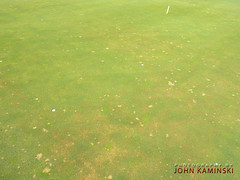
This time of year Microdochium patch symptoms on creeping bentgrass/annual bluegrass swards are typically water-soaked in the center of the patch with the perimeter of the patch exhibiting chlorosis. Patches this time of year typically range from 3 to 12 inches in diameter. The former name of this disease was pink snow mold. This was a bad name because snow is not required for disease development and the patches are not always pink. This is evident in the picture in the upper left corner of this post. The picture demonstrates the water-soaking in the center of the patch surrounded by chlorotic plants. You'll also notice the abundance of mycelium on the leaves, this is typical of Microdochium patch after incubation. Mycelium production can also occur in the field

Microscopic examination of the leaves coated in mycelium will reveal the crescent moon shaped spores. The spores have a prominent middle septation and lack a foot cell typical of Fusarium species. The second picture in this post represents typical Microdochium nivale spores. John, I loved your analogy of Lucky Charms for describing Microdochium spores. After Damon Smith mentioned the analogy to me, I used it to explain Microdochium to my graduate student. The one problem, he's from China and doesn't know what Lucky Charms are!


We also had a few leaf spot samples come through the clinic. We did not have red leaf spot, but the symptoms are fairly different from Microdochium patch. These symptoms are somewhat similar to what John described, irregular patches that have a reddish, brown tint. The samples that came through our clinic were induced by Bipolairs sorokinana most likely. The transition from last week to this week was fairly dramatic. The previous week was warm and this week the temperatures plummeted. Tonight there is a Freeze/Frost warning for Northern Wisconsin and the Upper Peninsula of Michigan. So we quickly transitioned from summer to fall!


The spores of leaf spot fungi are quite different. The spores are humongous compared to Microdochium spores, have a brown tint and have 6 to 10 septations.

Many golf course superintendents are making a fall application of vincozolin and chlorothalonil or iprodione and chlorothalonil to clean up any late season dollar spot and outbreaks of Microdochium patch. These are good combos for Microdochium and should provide good control until snow mold applications are made. Thiophanate-methyl is fairly effective against Microdochium as well.

Large patch is brewing in the warm-season grasses


With cool, wet weather setting in across much of the southeast, now is the time to initiate a preventive fungicide program for large patch on the warm-season grasses. Zoysiagrass, centipedegrass, and St. Augustinegrass are most prone to this disease; large patch rarely causes significant damage to bermudagrass turf. Not all turf needs to be treated with fungicides to control large patch, but areas that have sustained severe damage in the past should be sprayed on a preventive basis.

One great advantage of the warm-season grasses is that they are fairly resistant to diseases; in most parts of the southeast, we only need to worry about one or two diseases on these grasses. Spring dead spot is a major problem on bermudagrass, and large patch can cause severe problems on all the others - zoysiagrass, centipedegrass, and St. Augustinegrass.

One problem with large patch is that it comes at a time when the warm-season grasses are shutting down for the winter or greening-up in the early spring. As a result, the potential for recovery once symptoms appear is slim to none. Once an outbreak occurs, you're probably going to be looking at those symptoms until April or May when the turf really starts growing again.

The other problem with large patch is that the appearance of symptoms is very unpredictable. Sometimes they appear in late summer, other times during the fall, and in many cases no symptoms are observed in the spring. So how are you supposed to prevent the symptoms if you don't know when they are going to appear?

The answer is easy - don't time your fungicide applications based on when symptoms have appeared in the past. Instead, you should time applications based on when the pathogen is active. As it turns out, we know that the large patch pathogen becomes active when soil temperatures consistently dip below 70 degrees at the 1 to 2 inch depth. In other words, NOW IS THE TIME TO START PREVENTIVE PROGRAMS FOR LARGE PATCH IN MANY AREAS!

There has been much confusion over the name of this disease, and as a result, very few fungicides are specifically for 'large patch'. Some labels still refer to the disease as 'brown patch', whereas others call it 'zoysia patch'. Since they are all caused by Rhizoctonia solani, any fungicide that has one of these diseases on the label can be used for large patch control.

In some cases, one well-timed fungicide application in the fall can provide season long control of large patch. However, in severely affected sites, where disease pressure is high, repeated applications are often necessary. Two applications in the fall, 4 to 6 weeks apart, and one application in the spring when the turf is nearing full green-up is the ideal program. If three applications are not possible financially, the fall applications are probably more important than the spring application.

Strong brown patch fungicides like Heritage (0.4 oz of 50WG or 2 fl oz of TL), Insignia (0.9 oz) and ProStar (2.2 oz) are very effective for large patch control. Some of the DMI fungicides, Bayleton (1 oz) in particular, have performed very well also. Recent trials have also shown that Headway (3 fl oz), a pre-mix of Heritage and Banner, is a very effective large patch fungicide.

For more information about large patch management with fungicides and cultural practices, please refer to our Large Patch Disease Profile on TurfFiles.

some dollar spot info, and another new tree disease


It is hard to believe that there are only a few more days in September.

It is pretty quiet on the disease front. Dollar spot and large patch are the major issues.

First, I have to correct a typo from last time. I had listed a dollar spot fungicide treatment with Trinity as 0.1 oz/1000 and in fact it was 1.0. Apologies for any confusion.

Posted below are treatments from another dollar spot study that was conducted in a stand of A4 at our research center in Manhattan. I had a figure ready to go, pasted it, but then when I actually uploaded it turned to gibberish. Then, did it again. So I'll just type in a summary of the information:

All treatments were applied on a 14-day interval at 2 gal/1000


TREATMENTS & OZ/1000
1) untreated
2) Triton Flo, 0.5
3) Triton Flo, 0.75
4) Triton Flo, 1.0
5) Banner Maxx, 2.0
6) Reserve, 2.8
7) Reserve, 3.2
8) Reserve, 3.6
9) Reserve, 4.5
10) Concert, 5.0

On August 27 and Sept 10 the % dollar spot in the untreated plots was 9 and 15%, respectively. On Aug 27th, all the fungicides held dollar spot to zero. On 10 September, Banner Maxx, Concert, and Reserve at the 3.6 oz rate held dollar spot to zero, and the others all had just traces of disease, no more than 1% plot damage.


New disease on black walnut:

I know this is a turf blog but I also work with trees and ornamentals and I have sneaked in some tree stuff here before. If you don't care about trees, just skip it, but I do get a lot of questions about trees & ornamentals in golf courses so thought I'd pass in this news.

Dutch elm disease, chestnut blight, emerald ash borer, Asian longhorn beetle, sudden oak death... You might have heard of some of these tree diseases and insect pests.

There are always new problems arising to threaten our tree resources.

There is a new insect-fungus complex killing lots of black walnut trees in Colorado.
(I also know that a few folks consider black walnut a pesky tree because of the mess made by the nuts, but it is also a valued landscape tree in many sites, as well as an important part of native forests in the eastern half of the US).

Plant pathologist Ned Tisserat (formerly at K-State, now at Colorado State) and entomologist Whitney Cranshaw (Colorado State) have been working on this disease, and this past week representatives from other states in the region were in Denver to see the disease first-hand, learn about the biology and current research, and practice diagnosing it in the field.

There was a contingent of 7 from Kansas (yours truly and one more from KSU, three from the KS Forest Service, and two from the Kansas Department of Agriculture) who attended.

I took numerous photos and tried to post some here but, like with my dollar spot figure, I kept getting weird errors. D'oh! There are pics available in the link below.

The Colorado team showed us black walnuts in various stages of decline, then at two sites we had the opportunity to cut into several felled trees to look for the tiny beetles (adults and larvae were present), the canker symptoms, and the fungus. As we all know, there’s nothing better than field experience to really learn about a new disease or insect.

In Colorado, black walnut is only in landscape plantings. Here in Kansas and in other states up and down the plains we have both landscape and native black walnut, and we also have an important walnut timber industry. Regional plans are evolving to try to prevent spread of the disease, and to deal with the disease if it does appear in new states.

For more information about this disease, and photos, you can visit this website:

http://www.ext.colostate.edu/pubs/insect/0812_alert.pdf

End of the Summer? Says Who?


"Frank, do you know what fire ants look like? Well, you should, because you're standing on top of a whole bunch of them..."
- David Hay, CGCS, Indian Wells Country Club

It's been a long week starting in Monterey at Mike McCullough's Northern California Golf Association's Assistant Superintendent's Boot Camp, leading to Harding Park in San Francisco and culminating in Palm Desert today. To the left, you can see our Pythium trials being conducted in collaboration with Tom Shephard at Desert Falls GC. I'm using indicator dye in my spray tank, so you can see my spray uniformity (or lack of!). Everytime I head to Coachella to do work - I can't help but think about the impromtu lesson on fire ants that I got from David Hay.

As far as Pythium - anytime night time temps are over 68F during the overseed, you're at risk for an outbreak. With night time temps in the 70s for the next few days - definitely watch out for Pythium developing if you are overseeding in the desert this week!

It's the Fall, and it doesn't quite feel like it....
Yes, it's late-September and it's supposed to be cooler, but we're still getting triple digit temps here in parts of California. Anthracnose and summer patch are still active on Poa greens inland, whie rapid blight is coming back in cooler coastal areas.

If you're about to aerify, nitrogen applications at this time should help reduce down both anthracnose and summer patch. Don't hestitate to give greens a healthy shot of N at this time. If you've got lots of anthracnose, a solid fungicide application wouldn't hurt either. If you have lots of active anthracnose now, it could come back to bite you in basal rot form if you go into the winter with weak greens.

Since rapid blight is encouraged by mechanical damage (like top dressing) - make sure to leach salts before aerification. If you've historically been at risk for rapid blight in the early fall, make a Insignia/Compass plus mancozeb soon after aerfication and top dressing on Poa greens.

2009 UCR Field Day
Last Thursday, we held a very succesful field day at UCR with over 160 participants. Thanks to our sponsors Aquatrols, BASF, Bayer Environmental Science, Dow AgroSciences, Green As It Gets, Inc., Grigg Brothers, Gowan Turf & Ornamental, RootGel West, Syngenta Professional Products and Valent Professional Products for helping us with our tent and BBQ lunch!

Turf disease -wise, I got to show off our anthracnose plots and results from 2009 trials which focused mainly on new DMI fungicides. A preliminary report can be found here. Also, we got to discuss results from our spring dollar spot trials. That report can be found here.

Signing off from the Left Coast until next week......


Red Leaf Spot Active...


Disease activity has basically gotten to a point of boredom for many of us who like to see new and exciting diseases. Dollar spot continues to be the number one problem in the Northeastern United States and this is not much of a departure from the past few weeks or so. Temperatures are finally getting cooler at night, but the forecast for some areas have temperatures reaching into the 80's again this week.

Much of the effort in terms of turfgrass management has shifted towards the necessary cultural practices needed to ensure healthy turf heading into the winter and also coming out of spring. Snow mold applications are still a couple of months away, but superintendents would be wise to check out some of the posts from Dr. Kerns in the Midwest region where he experiences some of the highest snow mold pressures around.

For me, last week was fairly exciting (although not exciting enough to come up with another PlayTurf cover) as some of our plots unexpectedly developed red leaf spot. While at Maryland, we heard a lot of buzz from superintendents in the field who felt that they were dealing with red leaf spot. However, upon further inspection we almost always found the disease to be late cases of Microdochium patch (aka, Pink snow mold or Fusarium patch) occuring during overcast weather. This caused some controversy to the point of almost having a manuscript rejected because the editors suggested that we did not probably identify Microdochium patch (the disease was rated in the first week of June in Maryland...which was highly unusual). I assured the editors that I was a major advocate of the cereal Lucky Charms and could easily distinguish my "crescent moon shapes" (typical of Microdochium) from that of a cigar (typical shape of the Dreschlera genus that causes red leaf spot).

Anyway, the real first time that I even saw red leaf spot was at the research plots at my first University of Massachusetts field day. I took out the trusty pocket knife and took a small sample back to the lab at UConn and sure enough...red leaf spot (sorry for whose ever plots those were...I only took a small piece). In reviewing the latest turfgrass fungicide updates from the University of Kentucky, the reports from Paul Vincelli generally hold true with the data collected from the unexpected disease in our plots. Our data suggest that the QoI fungicides held up equally well (Disarm did seem to provide slightly less control, but this was not significant). Although ProStar did not enhance disease activity in our plots as suggested by Dr. Vincelli, it definitely did not provide any suppression. Two surprises in the data relative to past trials were that myclobutanil (Quali-Pro) seemed to provide excellent preventive suppression AND that Emerald (which is only good for dollar spot and bentgrass dead spot) seemed to provide a moderate level of suppression of the disease.

Since this is my first time seeing data on red leaf spot in my own plots, please feel free to comment on your thoughts about the disease in trials conducted in your region. As with Jim's post last week about the lack of control with Curalan for early season dollar spot, we may continue to see differences in control of certain diseases based on these geographic regions.
Related Posts with Thumbnails