

Hello again, its been a few weeks since I have posted anything. Except for the news about PCNB, the fall has been exceptional in the Midwest. Temperatures have been very conducive for golf, almost too conducive. I wonder if those who lost turf this summer had any difficulty recovering because of too much traffic during the fall season. Samples completely halted at the Turfgrass Diagnostic Lab around October 1st, mainly because we were fairly dry. The only disease that proliferated during the fall was rust, even some golf course superintendents called about massive amounts of rust in the roughs.
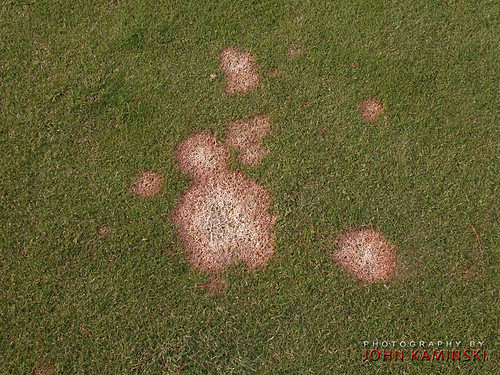
For those that had to select an alternative to PCNB there are a few things to consider for next year. First, one of the beauties of PCNB was its long residual control of Microdochium patch. Thus if Microdochium patch is observed after melt, than a follow-up fungicide application maybe warranted. Our research has shown that the fungicides iprodione and chlorothalonil only provide about 30 to 40 days of Microdochium patch control under winter conditions. Interesting enough we did not see extended control when comparing plots covered in snow versus those plots that were kept uncovered. The image above shows the length of control we observed with chlorothalonil. In other words, do not blame your snow mold fungicide mixture if new Microdochium patch infection centers develop during the spring immediately following melt.
The other thing to keep in mind is the issue with PCNB has not been resolved, at least not to my knowledge. Basically it would be wise to think about budgeting for snow mold without using PCNB as an option. That way you are prepared if the stop sale is not lifted. There are a number of options that I have already covered in previous posts, but feel free to contact us if you want to discuss other options for next year.
Most of the bloggers attended in the Agronomy meetings in Long Beach, California last week. I love these meetings because of the breadth of information presented. One of my favorite talks from the meetings, besides my own students', was given by one of Dr. Frank Rossi's students David Moody. He has determined that potassium applications in the fall may make turf more susceptible to snow mold damage. They established a very elaborate growth chamber experiment to test this hypothesis, but they stumbled upon this observed causally in the field. Basically they think the excess potassium stimulates the plant to shuttle potassium, citrate and malate into the vacuole in order to maintain osmotic potential. In turn this shift in osmotic potential slows down the production of carbon skeletons and energy, which are essential to plant defense. I believe this was the first or second year of David's research and I will be interested to follow his results and progress.
One of the highlights of the meeting was an outside meeting to discuss a proposal for a Multi-State Regional Project on Dollar spot research. This is a formal process that will allow all those who participate to meet once a year to discuss dollar spot research. Originally this idea was spearheaded by Dr. Mike Boehm at Ohio State University, but the reins was passed to Lane upon Dr. Boehm's promotion into upper administration at Ohio State. The beauty of this meeting was hearing what everyone was doing and realizing that very few turf programs overlap with respect to dollar spot research. This project has a five year term, so maybe in five years we will have a better handle on the biology of dollar spot!
Stay tuned next week as we start a series of discussions on the newer fungicides released in the past couple years!